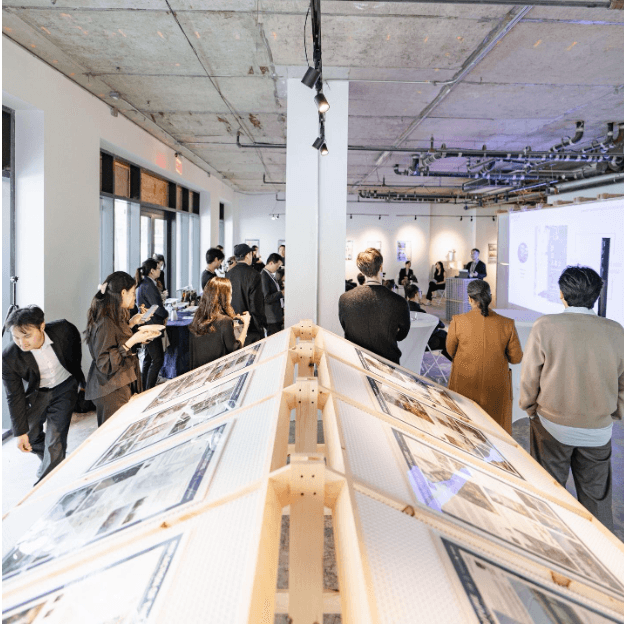

REALM | Nomad Group NYC presented Reflection of the Future, a landmark international design exhibition staged at 501 9th Avenue — at the seam between Hell’s Kitchen’s industrial legacy and the forward-thrust horizon of Hudson Yards. The exhibition drew over 2,500 onsite visitors across its ten-day run, presenting more than 2,000 digital works from over 40 leading global design teams across architecture, urbanism, AI, and interior design.
At its core, the exhibition staged an unprecedented East–West dialogue — contrasting Shenzhen’s velocity of urban prototyping with New York City’s accumulated depth of architectural and institutional history. Rather than presenting these two cities as opposites, Reflection of the Future framed them as complementary lenses through which to examine the most urgent questions facing the built environment: how capital flows shape culture, how ecology must be embedded in construction, and how AI is quietly restructuring the design profession itself.
Positioned between two of Manhattan’s most symbolically charged neighborhoods, the choice of 501 9th Avenue was itself an act of curatorial intent — a space where the industrial past and the speculative future press against each other, making the exhibition’s central tension physically felt. That tension would reach its most articulate expression five days into the run, when REALM convened a dedicated panel talk that brought the exhibition’s intellectual ambitions into direct confrontation with the realities of global capital, civic responsibility, and market forces.
ARCHITECTURES OF TOMORROW — THE VALUE EQUATION PANEL TALK· Photo 2: REALM Nomad Group
Contents
ARCHITECTURES OF TOMORROW — THE VALUE EQUATION
Panel Talk within Reflection of the Future · May 7, 2026 · 400 W 38th Street, New York
On the evening of May 7, midway through the exhibition’s ten-day run, REALM | Nomad Group NYC convened a panel discussion that distilled the exhibition’s central provocation into live, adversarial dialogue. Titled “Architectures of Tomorrow — The Value Equation,” the event assembled five of New York’s most authoritative voices across architectural practice, landscape urbanism, civic advocacy, urban economics, and global real estate capital. The room was a deliberate convergence: developers, architects, urban planners, and the emerging generation of practitioners who will inherit the skyline.
Host and moderator Ruxuan Zheng framed the evening with a question the field has long struggled to answer: in a global gateway like New York City, where the built environment exists at the brutal, fascinating collision point of qualitative design and quantitative capitalism, how do we decode what ‘value’ actually means? The evening’s structure was equally deliberate — five consecutive twenty-minute presentations, each a distinct analytical lens, followed by a Peer Review Q&A that collapsed the disciplines together and exposed the friction between them.
“Building in this city is a high-stakes endeavour,” Zheng told the audience at the opening. “How do we measure the ROI of exceptional architecture? How do we ensure public spaces thrive while still satisfying private capital? Tonight is about the actual mechanics of urban development — stripping away purely aesthetic discourse to understand how future cities are funded, executed, and monetized.”
THE FIVE LENSES
THE CAPITAL / DESIGN CONFLICT · Adam Dayem
The panel opened with the question that underlies nearly every architectural commission: can immeasurable cultural value and the quantitative demands of real estate capital coexist, and if so, who bears the cost of the translation? Adam Dayem, Principal of Actual Office Architecture and Assistant Professor at Rensselaer Polytechnic Institute, met this head-on in his presentation, “Valuing Designing / Designing Value.” Dayem argued that the central tension every designer faces is not aesthetic but epistemological — architecture speaks in a language of affect, memory, and civic identity, while the development market operates entirely in the language of return on investment. The gap between these two registers is not a failure of either side; it is structural, and navigating it is the defining professional challenge of the contemporary architect.
In the Q&A, the panel pressed harder: when a designer is sitting across from a developer whose attention is fixed on a spreadsheet, what is the actual strategy for making the case for unquantifiable cultural value? Dayem’s answer engaged the room’s developers and investors directly — reframing design quality not as aesthetic preference but as long-term asset differentiation, reputational capital, and the kind of civic presence that makes a building, and a neighbourhood, genuinely irreplaceable.
THE HUMAN CAPITAL · Hao-Yeh Lu
Where Dayem examined the structural conflict from within practice, Hao-Yeh Lu grounded the conversation in the biographical. Lu, Co-Chair of the AIANY Emerging New York Architects Committee and Intermediate Architectural Designer at Fogarty Finger, addressed the specific pressures, mentorship deficits, and civic advocacy gaps that define the trajectory of young, international professionals attempting to translate academic ideals into commercial survival in one of the world’s most competitive markets.
His presentation mapped the journey from architecture school — where design ambition is cultivated in relative freedom — to the commercial firm, where timelines, budgets, and client mandates impose a very different set of constraints. The transition, Lu argued, is rarely addressed directly, and the resulting culture shock is one of the profession’s most persistent retention problems. His work through the AIANY Emerging New York Architects Committee is partly an attempt to close that gap: building mentorship structures and professional networks that give young designers the language and resilience to operate across both registers. The Q&A focused on what the single most critical intervention might be for the next generation of international talent entering the New York market.
THE ECONOMICS OF THE PUBLIC REALM · Yiqing Wu
Yiqing Wu, Senior Associate at Field Operations — the landscape architecture practice behind some of New York’s most transformative public spaces — reframed the discussion around a deceptively simple argument: landscape is not amenity. It is infrastructure, and like all infrastructure, it generates returns. Wu’s presentation demonstrated how the integration of green space with major sports programming and the ‘fan economy’ creates compounding economic uplift for surrounding real estate — a dynamic that private capital increasingly understands, even if public planning policy has been slower to codify it.
The argument is not merely theoretical. Activated green infrastructure, Wu showed, drives residential and commercial value premiums in adjacent parcels, reduces municipal service costs, and attracts the kind of sustained foot traffic that makes a neighbourhood’s retail and cultural ecosystem viable over the long term. The Q&A arrived at the panel’s most ethically charged question: as commercial activation intensifies around public space, how do designers and planners ensure that the space remains genuinely public — equitable, accessible, and welcoming to residents who are not there to spend money? The tension between the economic case for activation and the civic case for open access, Wu acknowledged, is one that Field Operations navigates on every project.
THE INSTITUTIONAL MACHINERY · Yuxiang Luo
If Wu explained how public space creates value, Yuxiang Luo explained how it gets financed. Luo, Principal at JLP+D, a certified urban planner, and the author of Creating the Metropolis — Spaces and Institutions of New York City, presented a forensic account of the Public-Private Partnership as the central mechanism through which New York City’s most ambitious civic and real estate interventions are structured and executed. His examples were precise: Brooklyn Bridge Park, the High Line, the Domino Sugar factory site, and the Gowanus rezoning — each a case study in how complex financial and policy architecture can align public benefit with private return, and each a site of ongoing negotiation between community interests and development capital.
Luo’s framework for structuring P3s that genuinely protect the public good was among the evening’s most concrete contributions. Three principles, he argued, are non-negotiable: communities must be active participants in decision-making from the outset, not consulted after the fact; P3 structures must generate sustainable, long-term revenue streams directed to community-led operations — the Business Improvement District model being the most proven instrument; and the state must invest in capacity-building at the neighbourhood level, as the Gowanus rezoning demonstrated, so that communities have the institutional expertise to hold private partners accountable. Asked what NYC’s model might offer cities globally, Luo’s response was characteristically direct: government’s role is to set rules that are fair and incentive-rich, then let market and community actors play. New York’s deliberate absence of a comprehensive master plan, and its innovative use of Transfer of Development Rights as a market-based redistribution mechanism, are not accidents — they are a philosophy.
MARKET PSYCHOLOGY & GLOBAL CAPITAL · Cathy (Zihui) Huang
The panel’s final lens was also its most clarifying. Cathy (Zihui) Huang, Founder and CEO of Acre NY Realty, delivered the perspective that every preceding speaker’s work ultimately depends on but rarely confronts directly: the market. Where Dayem examined what architecture should be, Lu examined who builds it, Wu examined how it generates value, and Luo examined how it gets funded, Huang examined what end-users and global investors are actually choosing — and why.
Her presentation decoded the behavioural and psychological patterns driving cross-border real estate capital into New York City: the role of social media in shaping lifestyle aspirations and neighbourhood perception; the gap between what buyers from different cultural contexts prioritise versus what North American architects and planners typically assume they want; and the speed at which these demand signals shift, making the five-to-ten-year development cycle an exercise in forecasting a moving target. The Q&A posed the evening’s most provocative question directly to Huang: based on what buyers and investors are demanding right now, what is one design trend that architects and planners believe is valuable — but the market actually doesn’t care about? Her answer, and the debate it ignited among the panelists, was the most animated exchange of the night.
The formal programme concluded with the Peer Review Q&A, which brought all five speakers back to the stage and opened the floor to audience questions. Moderator Ruxuan Zheng closed by articulating the evening’s underlying logic: an architect’s vision, to survive contact with the real world, requires a young designer’s execution, an economist’s structuring, and a broker’s understanding of the market. The panel had, for one evening, assembled exactly that coalition — and the conversation it generated extended well past the formal programme, into the networking reception that followed.
INSTITUTIONAL PARTNERS & SPEAKERS
The exhibition and panel convened a distinguished coalition spanning global design accreditation, NYC real estate, academic research, and cross-disciplinary practice:
- A’ Design Award and Competition · CEO Onur Mustak Cobanli One of the world’s most prestigious design accolades — 2.5 billion+ media impressions, 300+ Grand Jury Members across 180+ nationalities, and 138+ international media partners.
- ZD Jasper Realty · Vice President Jasper Wu Bridging visionary design ambition with actionable New York City real estate development.
- Shenzhen University — School of Architecture and Urban Planning (SAUP) · Dean Yue Fan & Vice Dean Yi Qi Presenting rigorous, research-led urban prototypes from one of China’s foremost architecture schools.
- Actual Office Architecture · Principal Adam Dayem · Assistant Professor, Rensselaer Polytechnic Institute Architectural theorist and practitioner examining the incommensurability of cultural value and capitalist development systems.
- AIANY Emerging New York Architects Committee · Co-Chair Hao-Yeh Lu · Intermediate Architectural Designer, Fogarty Finger Representing and building the next generation of practitioners reshaping New York’s built environment through civic advocacy and mentorship.
- Field Operations · Senior Associate Yiqing Wu The landmark landscape architecture practice behind transformative public spaces across the United States, reframing green infrastructure as economic engine.
- JLP+D · Principal Yuxiang Luo · Certified Urban Planner Author of Creating the Metropolis — Spaces and Institutions of New York City, and economic development strategist guiding P3 frameworks across North America.
- Acre NY Realty · Founder & CEO Cathy (Zihui) Huang Decoding cross-border buyer behaviour, global capital flows, and market psychology as determinants of the built environment.
- Pro-H · Owner Hung Pin Hung Cross-disciplinary expertise at the intersection of design and enterprise.
- PRO:JECT UOU · Founder Chih-Wei Hsu Experimental spatial practice contributing to the exhibition programme.
- ZULUECHO STUDIO · Founder Zain Elwakil Merging architectural vision with the precision of architectural photography.
- Yuxiang Luo — Independent · Urban Planner & Economic Development Consultant Author, Creating the Metropolis — Spaces and Institutions of New York City.
ARCHITECTURES OF TOMORROW — THE VALUE EQUATION PANEL TALK· Photo 3: REALM Nomad Group
THE SHENZHEN CONTINGENT
Eleven of Shenzhen’s most consequential architectural voices — studios that have collectively defined the grammar of China’s most experimental city — brought their work to New York:
- NODE Architecture & Urbanism — 南沙原创 · Liu Heng 刘珩
- Yuanben Studio — 元本体工作室 · Cai Ruiding 蔡瑞定
- SMARTLAND — 肃木丁建筑 · Ji Xiaolin / Ding Qiang 纪啮林 / 丁樯
- CCDI Dongxiying Studio — 悉地国际东西影 · Zhu Xiongyi / Wang Zhaoming 朱雄毅 / 王照明
- Mozhao Architects — 墨照建筑 · Zeng Guansheng 曾冠生
- ATELIER XI — 一树建筑工作室 · Chen Xi 陈曦
- FCHA — 坊城设计 · Chen Zetao 陈泽涛
- INGAME — 局内设计 · Zhang Zhiyang 张之样
- TALLER ARCITY — 趣城工作室 · Zhang Yuxing / Han Jing 张宇星 / 韩晶
- fabersociety — 梓集 · Zuo Long 左龙
- ARQUITECTOS TUMUSHI · Yang Qili / Bai Yan / Deng Wenhua 杨期力 / 白岩 / 邓文华
THE GLOBAL CONTINGENT
Alongside the Shenzhen representation, the exhibition assembled a curated selection of international studios and independent practitioners spanning architecture, AI-driven design, sustainability, and interior environments:
- TSC Architects · Yoshiaki Tanaka · Japan
- Iwasa Design Studio — 岩佐設計工房 · Hiroaki Iwasa · Japan
- Peter Kuczia · PhD, Architect & Writer
- actual / office · Adam Dayem
- PolyGone Systems · Yidian Liu & Nathaniel Banks
- A-01 · Oliver Schütte
- David Guerra Arquitetura e Interiores · David Guerra · Brazil
- AB Interior Design Buro · Alena Bulataya
- delazzari. · Bruno De Lazzari · Brazil
- Prairie View A&M University · Bill Price
- HEYSUPERSIMI · Simone Hutsch
- ATELIER OYU · Oyu
- Extended Play Lab · Xiyao Wang · Harvard University
- alborno · Fabrizio Alborno
- LILI DESIGN STUDIO · Yiqing Wu
- Mingrui STUDIO · Mingrui Jiang
- Yuchen | Architect · Yuchen Qiu
- Hao Zhong STUDIO · Hao Zhong
- FMP · Fei Hu
- FORMA CAPRICHOSA · Dagmara Oliwa
- Honeydew Rabbit · Junghye Yoon
- Sunny Jackson
- Hair from You · Zoe Ze Zhou
- Fureve.AI · Ding Li, Siqi Wu & Yi Cao
SPONSORS & PRIZES
Rigel Atlas Boutique Consulting · Atlas Caviar · Hadden Store · House of Balance
ABOUT REALM NOMAD GROUP
REALM Nomad Group is New York City’s premier platform for connecting the built environment’s most important constituencies — architects, developers, investors, and academics — through curated, high-calibre exhibition series. REALM exists to celebrate the critical work that determines how we build, finance, and inhabit the cities of tomorrow.