

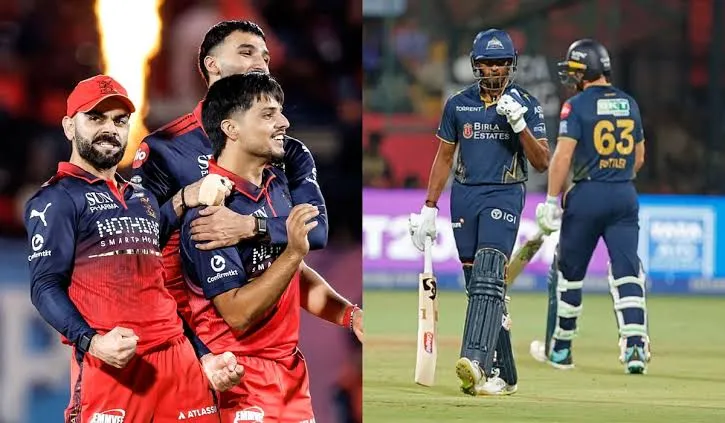
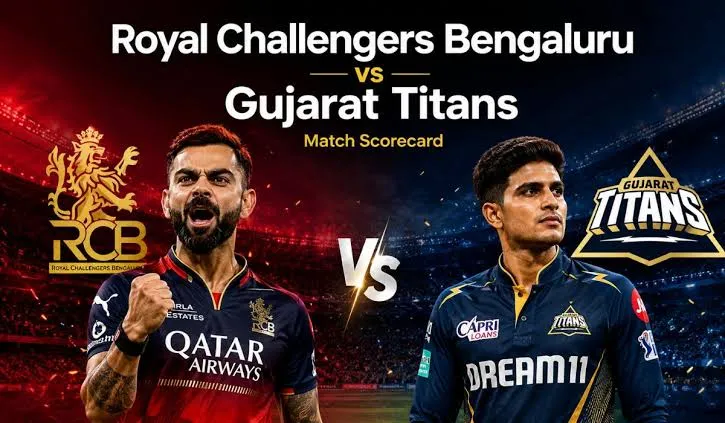
The Gujarat Titans vs Royal Challengers Bengaluru match scorecard from the IPL 2026 Final tells the story of a high-pressure contest decided by superior execution rather than a huge difference in talent. Royal Challengers Bengaluru successfully chased 156, finishing on 161/5 in 18 overs and winning by five wickets at Narendra Modi Stadium in Ahmedabad.
The final delivered everything expected from a championship match, including an early batting collapse, a determined recovery, aggressive powerplay batting, and a composed chase led by Virat Kohli. Gujarat Titans struggled to build partnerships after losing wickets regularly, while RCB maintained control for most of their pursuit.
For readers searching for the gujarat titans vs royal challengers bengaluru match scorecard today, the most recent completed fixture was the May 31, 2026 IPL Final. Gujarat Titans posted 155/8, while RCB reached 161/5 in 18 overs.
Contents
Match Overview and Key Highlights
The match began with RCB choosing to field after winning the toss, putting Gujarat under immediate pressure. That decision became important because the RCB seamers attacked the top order with disciplined lengths and prevented Gujarat from establishing an explosive start.
Match Date, Venue, and Conditions
The IPL 2026 Final took place on May 31, 2026, at Narendra Modi Stadium in Ahmedabad. The venue hosted a major championship encounter between two teams that had already demonstrated consistency throughout the season.
The gujarat titans vs royal challengers bengaluru match scorecard shows that the contest was completed without a weather interruption, allowing both sides to use their full allotted innings. Gujarat batted first and reached 155/8 from 20 overs.
The surface offered enough assistance for bowlers who varied their pace and attacked useful lengths. RCB’s seamers benefited particularly from the short-ball approach, which repeatedly forced Gujarat batters into difficult aerial shots. The official match report noted that six of Gujarat’s eight dismissed batters fell to short-length deliveries.
Toss Result and Teams’ Innings Summary
Rajat Patidar won the toss for Royal Challengers Bengaluru and chose to field. His decision gave RCB the opportunity to understand the pitch before beginning their chase.
Gujarat Titans lost Shubman Gill and Sai Sudharsan cheaply, leaving the middle order with the responsibility of rebuilding the innings. Nishant Sindhu contributed 20 from 18 balls, while Jos Buttler made 19 from 23 deliveries.
Washington Sundar became the central figure in Gujarat’s innings. He remained unbeaten on 50 from 37 balls, including five fours, and carried the batting effort through a difficult middle phase.
The gujarat titans vs royal challengers bengaluru match scorecard therefore reflects an innings built more on recovery than domination. Gujarat finished at 155/8, leaving RCB a target of 156.
RCB immediately attacked that target through Venkatesh Iyer and Virat Kohli. Their partnership reached 50 in only 3.3 overs, providing the defending champions with a major advantage.
Final Score and Result Outcome
Gujarat Titans finished with 155/8 from their 20 overs, producing a run rate of 7.75. Royal Challengers Bengaluru responded with 161/5 from 18 overs at a run rate of 8.94.
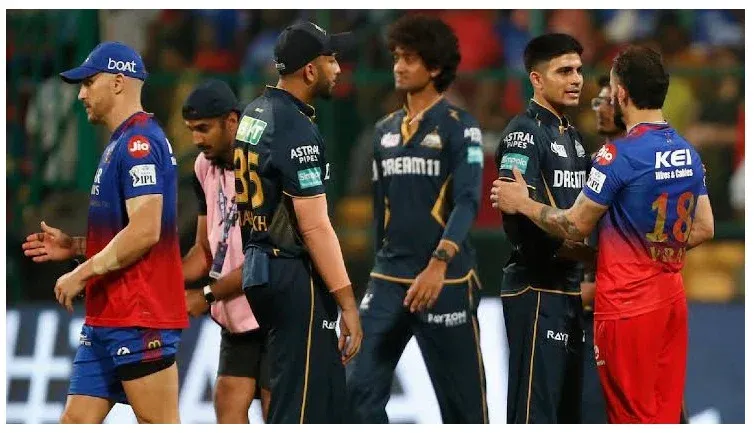
The gujarat titans vs royal challengers bengaluru match scorecard confirms that RCB won by five wickets with 12 deliveries remaining. The victory secured back-to-back IPL championships for RCB and their second IPL title overall.
The result was especially significant because Gujarat had reached another IPL final after a strong campaign. Their inability to convert a respectable 155 into a competitive defense ultimately proved decisive.
RCB’s successful chase was based on a fast beginning followed by Kohli’s controlled acceleration. The batting unit avoided unnecessary risks when wickets fell and kept the required rate within reach.
Key Moments and Turning Points
The first major turning point came during Gujarat’s powerplay. Shubman Gill fell for 10 and Sai Sudharsan followed for 12, putting Gujarat behind the expected scoring curve.
The second major moment came when Washington Sundar stabilized the innings. His unbeaten half-century prevented Gujarat from collapsing completely and gave the team a total that at least offered their bowlers something to defend.
The gujarat titans vs royal challengers bengaluru match scorecard also highlights Rasikh Salam’s three-wicket spell. His dismissals of Nishant Sindhu, Rahul Tewatia, and Rashid Khan restricted Gujarat’s late acceleration.
For RCB, the biggest turning point was the opening partnership. Venkatesh Iyer’s 32 from 16 balls created immediate pressure before Kohli took control of the chase.
Even when Gujarat briefly fought back through Rashid Khan, Kohli continued to manage the innings intelligently. His unbeaten 75 from 42 balls eventually made the target comfortable.
Detailed Gujarat Titans vs Royal Challengers Bengaluru Match Scorecard
A detailed reading of the gujarat titans vs royal challengers bengaluru match scorecard reveals two very different batting approaches. Gujarat depended on one substantial individual contribution, while RCB received aggressive support at the beginning and a match-winning anchor at the other end.
The scorecard also demonstrates why the final result was not determined simply by the difference between 155 and 161. The timing of runs, wickets, partnerships, and pressure situations mattered far more than the six-run difference in totals.
Batting Performance – Gujarat Titans
Gujarat’s innings began with pressure after Sai Sudharsan departed for 12 from 12 balls. Shubman Gill scored 10 from eight deliveries before Josh Hazlewood removed him.
Nishant Sindhu provided some resistance with 20 from 18 balls. His three boundaries helped Gujarat recover temporarily, but Rasikh Salam eventually dismissed him.
Jos Buttler’s 19 from 23 balls was another important but slow contribution. His dismissal through a stumping by Jitesh Sharma ended another potential rebuilding partnership.
Washington Sundar was clearly Gujarat’s standout batter. His 50 not out from 37 balls included five fours and came at a strike rate above 135. His innings was particularly valuable because he remained composed while wickets continued to fall.
Arshad Khan then produced a rapid cameo of 15 from six balls, striking two sixes. However, Hazlewood removed him before Gujarat could transform that momentum into a larger total.
Rahul Tewatia, Jason Holder, Rashid Khan, and Kagiso Rabada provided useful late runs, but Gujarat finished at 155/8.
The gujarat titans vs royal challengers bengaluru match scorecard therefore shows a Gujarat innings that never fully recovered from its early losses.
Batting Performance – Royal Challengers Bengaluru
RCB’s response was built around aggressive intent from the opening delivery. Venkatesh Iyer scored 32 from 16 balls, striking four fours and two sixes at a strike rate of 200.
His partnership with Kohli quickly changed the nature of the chase. RCB reached 50 in just 3.3 overs, which the official IPL report identified as the fastest team fifty in an IPL final.
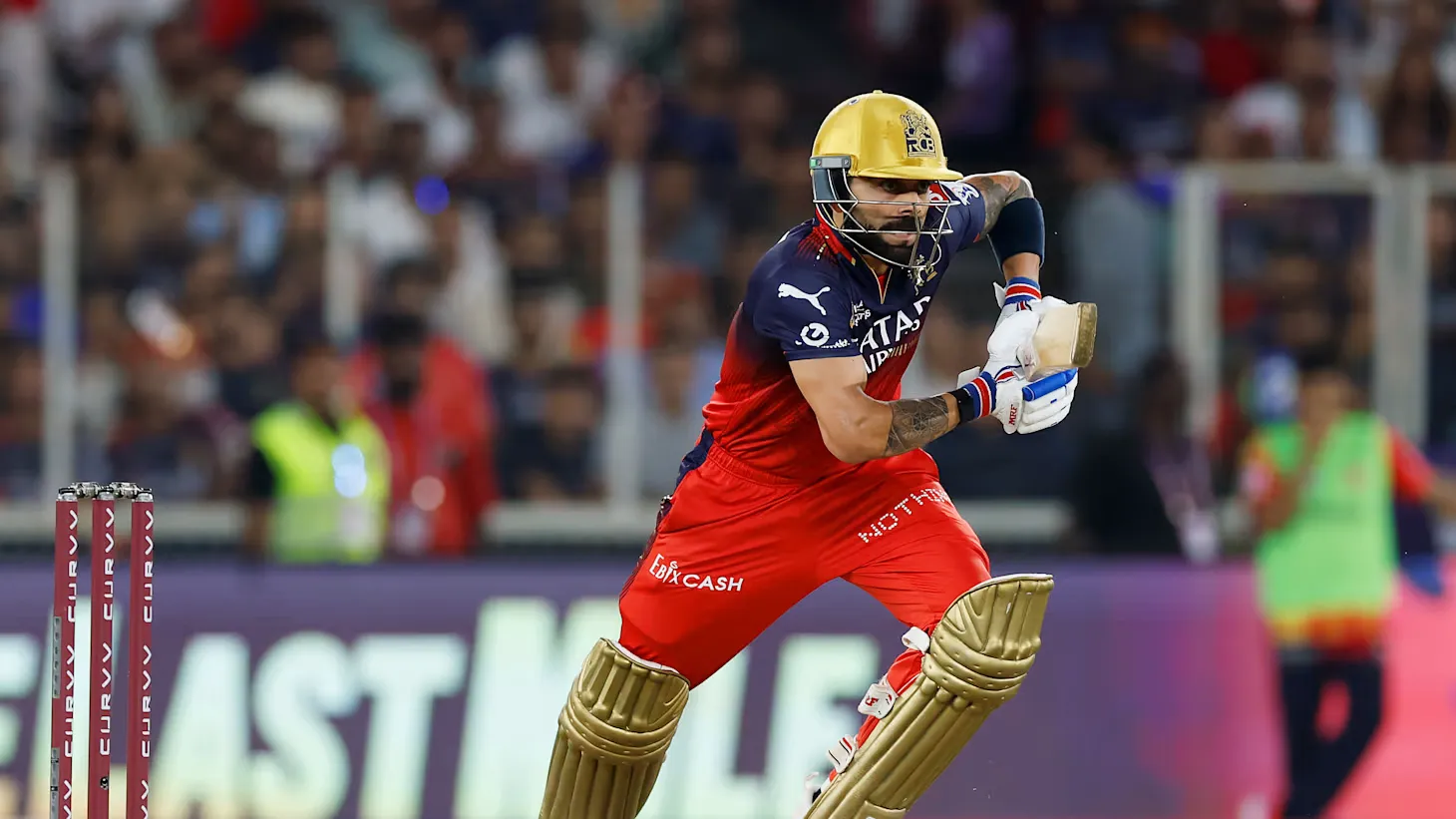
Kohli then transformed the advantage into complete control. He finished unbeaten on 75 from 42 balls, with nine fours and three sixes. His strike rate of 178.57 reflected a balance between calculated aggression and risk management.
Rajat Patidar scored 15, while Devdutt Padikkal made only one. Krunal Pandya also fell for one, creating a brief opportunity for Gujarat.
Tim David answered the pressure with 24 from 17 balls. Jitesh Sharma remained unbeaten on 11, providing enough support for Kohli to finish the chase.
Bowling Figures – Gujarat Titans
Rashid Khan was Gujarat’s most economical bowler. He completed four overs for 25 runs and claimed two wickets, dismissing Rajat Patidar and Krunal Pandya.
Arshad Khan also took one wicket while conceding 32 runs from four overs. Mohammed Siraj claimed Venkatesh Iyer after conceding 36 runs.
Kagiso Rabada dismissed Devdutt Padikkal but conceded 44 runs from three overs. Jason Holder and Prasidh Krishna completed the bowling attack without taking wickets.
The gujarat titans vs royal challengers bengaluru match scorecard makes it clear that Gujarat’s bowling had isolated moments of success, but it could not consistently slow Kohli.
Bowling Figures – Royal Challengers Bengaluru
RCB’s bowling unit produced the foundation for the victory.
Rasikh Salam delivered the best figures, taking 3/27 from four overs. His wickets at important stages stopped Gujarat from building a dangerous finish.
Bhuvneshwar Kumar took 2/29 from four overs, while Josh Hazlewood collected 2/37. Hazlewood’s dismissal of Shubman Gill was particularly important because it prevented the Gujarat captain from establishing an innings.
Krunal Pandya took one wicket for 23 runs from four overs. Jacob Duffy completed his four overs for 38 without taking a wicket.
Fielding and Extras
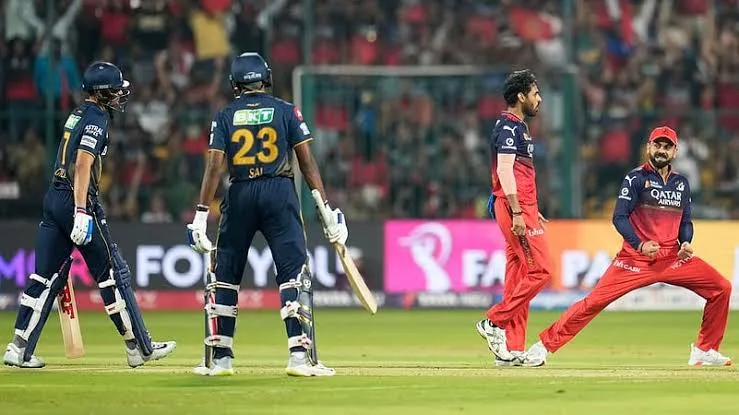
Fielding played an important supporting role throughout the contest. RCB’s players held crucial catches and Jitesh Sharma completed the stumping of Jos Buttler.
Rajat Patidar took catches to dismiss Shubman Gill and Rahul Tewatia. Devdutt Padikkal also completed a catch against Nishant Sindhu.
Gujarat conceded only two extras during the chase, consisting of one wide and one leg bye. Gujarat’s innings contained five extras, including four wides and one leg bye.
The gujarat titans vs royal challengers bengaluru match scorecard therefore indicates that neither side suffered a major extras problem. The result was determined primarily by batting efficiency and wicket management.
Player Performances and Impact Analysis
The most valuable way to interpret the gujarat titans vs royal challengers bengaluru match scorecard is to look beyond raw totals. Championship matches often turn on players who influence momentum at specific moments.
RCB had several such contributors. Kohli was the obvious match winner, while Iyer provided the initial acceleration and Rasikh Salam helped prevent Gujarat from reaching a larger total.
Man of the Match: Performance Breakdown
For anyone searching for the gujarat titans vs royal challengers bengaluru match scorecard man of the match, the answer is Virat Kohli.
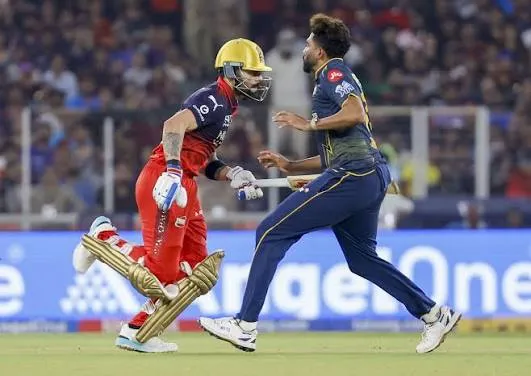
Kohli scored an unbeaten 75 from 42 balls, hitting nine fours and three sixes. He reached his half-century from only 25 balls before shifting into a more controlled mode.
His contribution was not merely statistical. Kohli absorbed pressure whenever Gujarat threatened to regain control.
After Rashid Khan dismissed Patidar and Krunal Pandya in quick succession, RCB had moved from a comfortable position into a potentially uncertain phase. Kohli responded by maintaining his tempo and preventing the required rate from becoming dangerous.
His unbeaten finish also meant that RCB did not need a dramatic final over. Jitesh Sharma supported him as the defending champions crossed the line with two overs remaining.
The official IPL report identifies Kohli as the Player of the Match and describes his innings as the defining performance of RCB’s title-winning campaign.
Impact Player List and Contributions
Readers searching for the gujarat titans vs royal challengers bengaluru match scorecard impact player list will find that Venkatesh Iyer was especially influential for RCB.
Iyer entered as an Impact Player and immediately justified the tactical decision. His 32 from 16 balls gave RCB an outstanding start and helped produce the fastest team fifty in an IPL final.
The recorded RCB Impact Player exchange was Venkatesh Iyer replacing Jacob Duffy. For Gujarat, Prasidh Krishna came in for Rahul Tewatia under the Impact Player mechanism.
Iyer’s role was important because RCB did not need to depend exclusively on Kohli from the beginning. His explosive contribution created enough breathing room for Kohli to construct the chase.
Rasikh Salam was another major impact figure, although his value came with the ball rather than through the Impact Player substitution.
Notable Individual Performances from Both Teams
Washington Sundar deserves significant credit for Gujarat. His unbeaten 50 from 37 balls prevented the Titans from suffering a much heavier defeat.
Arshad Khan’s 15 from six balls was another useful late contribution. His two sixes briefly suggested Gujarat could push beyond the 160 mark.
Rasikh Salam’s 3/27 was the best bowling performance of the final. His ability to strike at crucial moments prevented Gujarat’s lower order from generating sustained momentum.
For RCB, Venkatesh Iyer’s strike rate of 200 was an early statement, while Kohli’s 75 not out became the decisive contribution.
The gujarat titans vs royal challengers bengaluru match scorecard man of the match discussion therefore naturally centers on Kohli, but the title was produced by a broader team performance.
Tactical Moves and Their Impact on the Match
RCB’s most important tactical move was the decision to bowl first after winning the toss. The seamers then used short-length bowling to attack Gujarat’s batting weaknesses.
The strategy worked against both Gill and Arshad Khan, while other Gujarat batters also struggled against deliveries that prevented them from comfortably freeing their arms.
Another tactical success was the promotion of Venkatesh Iyer. Instead of asking him to bat later, RCB used his aggressive approach at the top.
Gujarat’s use of Rashid Khan also created a temporary comeback. His double strike against Patidar and Krunal Pandya reduced RCB to 91/4.
However, Gujarat could not turn those wickets into a larger collapse because Kohli remained at the crease.
The gujarat titans vs royal challengers bengaluru match scorecard impact player list therefore demonstrates how tactical substitutions can influence momentum, but execution still determines whether that advantage becomes decisive.
Bangalore Versus Gujarat: Comparative Team Analysis
The bangalore versus gujarat rivalry has developed into an increasingly competitive IPL matchup, with both franchises capable of dominating different phases of a game.
The 2026 season provided several examples of this balance. RCB defeated Gujarat in the April 24 league meeting, Gujarat answered with a victory on April 30, and RCB then won the playoff meeting before taking the final.
That sequence provides useful context for understanding the final. The teams were familiar with one another, and neither side entered the championship match without experience against the other’s tactics.
Head-to-Head Records and Historical Context
The bangalore versus gujarat contest has produced different results across seasons because the teams have often approached matches with contrasting strengths.
Gujarat have generally relied on structured batting partnerships and disciplined bowling combinations. RCB have frequently emphasized top-order aggression and experienced match management.
The 2026 season intensified the rivalry. RCB won the April 24 league encounter by five wickets after chasing 206, while Gujarat responded four days later with a four-wicket victory after restricting RCB to 155.
RCB then defeated Gujarat by 92 runs in Qualifier One, scoring 254/5 before bowling the Titans out for 162. That result sent RCB directly into the final.
The final produced another RCB victory, making the championship meeting particularly significant in the context of their 2026 rivalry.
Strengths and Weaknesses Observed in the Current Match
The bangalore gujarat matchup exposed a clear contrast between the teams.
RCB’s strongest quality was their ability to create momentum immediately. Their powerplay batting reached 70/2, while their bowling attack removed Gujarat’s leading batters early.
Gujarat’s strongest quality was resilience. Despite losing wickets regularly, Washington Sundar remained composed and carried the innings to 155.
The primary weakness for Gujarat was the lack of sustained partnerships. Their fall of wickets occurred at 22, 26, 55, 73, 99, 115, 142, and 151, showing how consistently RCB disrupted the innings.
RCB’s temporary weakness came when Rashid Khan removed Patidar and Krunal Pandya quickly. However, Kohli’s presence prevented the pressure from becoming a full collapse.
Player Form and Team Strategy Insights
The bangalore versus gujarat matchup also demonstrates why player roles matter as much as individual quality.
Kohli’s ability to remain at the crease allowed RCB to control the chase. His innings combined boundary hitting with risk management.
Venkatesh Iyer provided the opposite style. His responsibility was to attack immediately and disrupt Gujarat’s plans.
For Gujarat, Washington Sundar showed the value of an anchor who can survive pressure while still maintaining a respectable scoring rate. His 50 not out was the clearest example of Gujarat’s ability to recover.
Rasikh Salam’s bowling showed how wicket-taking at the right time can be more valuable than simply limiting boundaries.
The final also demonstrated that a team does not necessarily need the highest individual bowling figures across every player. RCB’s collective attack created enough pressure to keep Gujarat below a truly imposing total.
Conclusion: Match Implications and Future Outlook
The gujarat titans vs royal challengers bengaluru match scorecard from the IPL 2026 Final ultimately describes a match where RCB controlled the most important phases.
Gujarat’s 155/8 was respectable because Washington Sundar rebuilt an innings that had repeatedly lost wickets. Yet the total was never quite large enough to put sustained pressure on an RCB side featuring Kohli, Iyer, and a deep batting lineup.
RCB’s 161/5 in 18 overs was powered by a remarkable opening burst and Kohli’s unbeaten 75. The defending champions did not allow the chase to become a final-over lottery.
For users searching gujarat titans vs royal challengers bengaluru match scorecard today, the key figures remain straightforward: Gujarat Titans made 155/8, Royal Challengers Bengaluru reached 161/5, and RCB won by five wickets.
The gujarat titans vs royal challengers bengaluru match scorecard man of the match recognition belongs to Virat Kohli, whose unbeaten 75 was the decisive batting performance. Washington Sundar’s unbeaten 50 was Gujarat’s standout contribution, while Rasikh Salam’s 3/27 led the RCB bowling effort.
The gujarat titans vs royal challengers bengaluru match scorecard impact player list also shows why tactical substitutions mattered. Venkatesh Iyer’s promotion gave RCB an explosive start, while Gujarat’s tactical changes could not produce enough wickets to stop Kohli.
From a broader bangalore versus gujarat perspective, the final was the clearest example of RCB’s ability to convert pressure into a championship result. Their victory was not based on one isolated moment but on coordinated bowling, aggressive opening batting, and exceptional control from Kohli.
The bangalore gujarat rivalry should remain compelling because both teams possess contrasting methods of winning. Gujarat can recover through structured partnerships and spin, while RCB can overwhelm opponents through aggressive batting and experienced game management.
Looking beyond this final, the biggest lesson for Gujarat is the importance of protecting the top order and creating more substantial middle-order partnerships. For RCB, the championship reinforces the value of maintaining pressure from the first over rather than relying on late heroics.
The gujarat titans vs royal challengers bengaluru match scorecard will ultimately be remembered not because of an enormous total or a last-ball finish, but because RCB executed the fundamentals better when the stakes were highest.
Their bowlers restricted Gujarat to a manageable score, their Impact Player decision produced immediate returns, and Kohli delivered the defining innings. That combination turned a competitive final into another championship victory for Royal Challengers Bengaluru.