
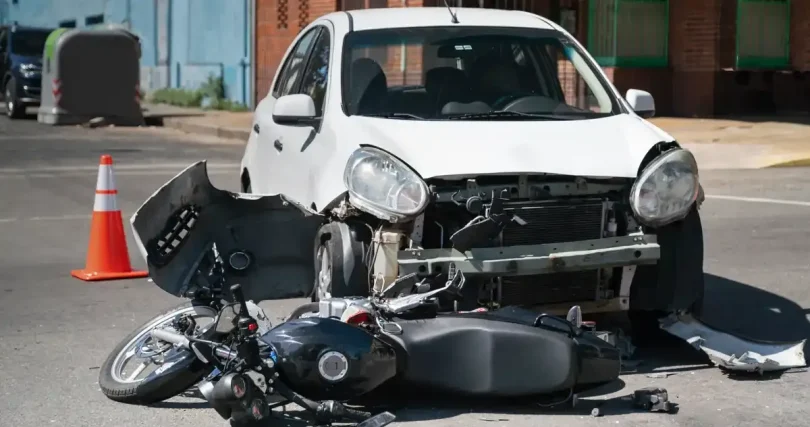

A decade ago, a motorcycle crash lived or died on the responding officer’s diagram and a couple of witness statements scribbled at the curb. The rider, often knocked around or hospitalized, wasn’t in any shape to correct the record.
Today the same rider frequently has a helmet-mounted camera that ran the whole ride, a chest cam clipped to a jacket, a phone mounted to the bars, and a GPS log timestamping every second. What happened is no longer a memory the rider has to defend. It’s a file sitting on a memory card.
That shift matters because insurers and prosecutors used to treat the police report as the outer limit of what could be widely used. Now it’s a starting point that video frequently contradicts, and riders who understand how their own footage will be read, challenged, and sometimes used against them are walking into these fights in a different position than riders who don’t.
Contents
The Left-Turn Case Where the Camera Rewrote Fault
The classic multi-vehicle motorcycle crash is a car turning left across the rider’s lane. The driver almost always says the same thing at the scene: the bike came out of nowhere, or it was going too fast to avoid. Without video, that story tends to stick, especially if the rider is unconscious or transported before giving a statement.
Helmet footage changes the geometry of the argument. A clean forward view shows the approach speed relative to fixed objects, the moment the car’s wheels break the plane of the lane, and the rider’s braking input in real time. According to NHTSA data, the majority of motorcycles in two-vehicle crashes are impacted in the front, meaning the camera pointed forward is usually pointed at the collision.
That footage is often the difference between a shared-fault finding that guts the recovery and a clean liability determination against the turning driver. A motorcycle injury attorney who gets the file early can pair the video with skid measurements and vehicle damage to lock in a version of events the insurer can’t quietly rewrite in adjuster notes.
The Single-Vehicle Crash Where Video Cuts Both Ways
Not every helmet cam saves the rider. In a single-bike crash, the footage may show a late apex, a missed brake point, or a speed that doesn’t square with the story told to the ER staff. Riders sometimes hand over video expecting vindication and instead give the insurer a clean liability defense.
This is where a candid conversation with counsel matters before anything gets uploaded to a cloud folder the other side can subpoena. Video is discoverable. Once it exists, deleting it after a claim is on the horizon can look like spoliation, which carries its own penalties in front of a judge. The right move is usually to preserve the file, review it honestly, and build the case around what the footage supports.
The Report-vs-Footage Fight Over Basic Facts
Police reports on motorcycle crashes are wrong more often than most people assume. Officers arrive after the fact, may not ride themselves, and lean heavily on the standing driver’s account while the rider is being loaded into an ambulance.
Video is one of the cleanest ways to correct a report without turning the case into a swearing contest. Timestamps establish sequence, audio picks up the driver’s spontaneous statements at the scene, and GPS overlays confirm speed.
None of this replaces the officer’s authority. It does give the rider’s version documentary weight the report can’t match on its own.
Preserve the Footage Before the Loop Overwrites It
The single most common way rider video disappears is the camera itself. Most action cams and dedicated dashcams record on a continuous loop and can overwrite crash footage within hours if nobody pulls the card. A bike that sits at a tow yard for two days with the camera still powered can lose the only objective account of the wreck.
- Pull the card immediately. Ask a family member or a friend to retrieve the camera and memory card from the bike or the tow lot before anything else. Do not let it sit.
- Copy, don’t edit. Make a bit-for-bit copy of the original file and work only from copies. Any trimming, stabilizing, or annotating should happen on duplicates so the original hash stays clean for authentication later.
- Send a preservation letter. If a nearby business, transit bus, or another rider may have captured the crash, get a written preservation demand out fast. Most systems cycle in days.
- Log the chain of custody. Write down who touched the card, when, and where the file lived. Sloppy handling is how good footage gets excluded.
Rider-worn video hasn’t eliminated arguments over motorcycle crash liability, but it has changed what those arguments are built on. The same footage that can dismantle an inaccurate police report or driver’s account can also expose mistakes by the rider, which makes preserving the original file — and understanding what it actually shows — just as important as having the camera in the first place.