
Most households that own silver have never looked at the underside of it. A set of forks from a grandparent, a serving tray that has lived in a sideboard for decades, a pair of candlesticks left in a will: all of them carry tiny stamped marks that tell you more about the piece than the shine does. Before you sell, insure or divide any of it, those marks are the first thing worth reading.
Contents
Why the marks matter
A mark on silver can tell you three things: how much of the object is actually silver, who made it, and, in some countries, where and when it was tested. That information is what separates a solid silver heirloom from a silver-plated one that looks identical on a shelf, and it is the starting point for any honest valuation or insurance conversation.
It also protects you. An insurer, an auctioneer or a family member dividing an estate will all ask the same question: what exactly is this made of? If you can read the marks yourself, you arrive at that conversation prepared instead of relying on someone else’s first impression.
The numbers: fineness marks
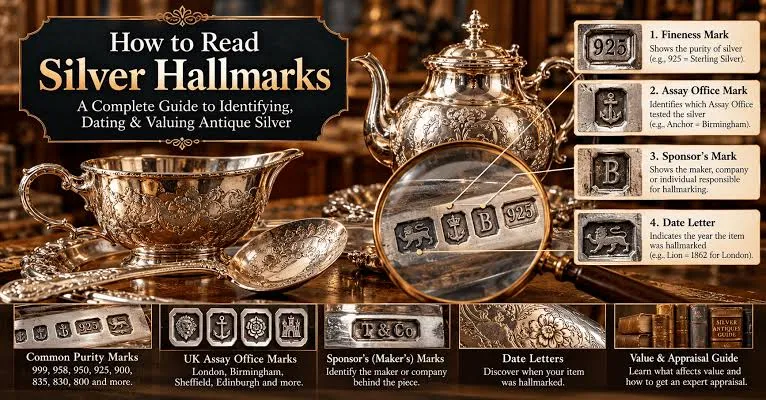
The most common thing you will find is a number. It expresses fineness, the proportion of pure silver in the metal, in parts per thousand. A mark of 925 means 92.5 percent silver, the standard known as sterling. A mark of 800 means 80 percent, a standard found on a great deal of continental European silver. Marks such as 950 and 999 point to higher purity, with 999 indicating what is usually called fine silver.
Sterling is alloyed with other metals, most often copper, because pure silver is too soft for objects used every day. That is why a sterling fork keeps its shape and a fine silver one would bend. The number does not tell you whether an object is beautiful or valuable to a collector, only how much silver the metal contains.
Maker’s marks and assay marks
Alongside the number, many pieces carry a small stamp that identifies the maker or workshop, often a set of initials or a symbol in a shaped outline. In a number of countries, an official testing office adds its own stamp, which is why you may see several tiny marks in a row. Italian silver, for instance, typically carries a number for the fineness together with a star and a code identifying the maker.
Older pieces may include extra symbols, such as a letter indicating the year of manufacture. These are the marks that turn an ordinary object into one with a documented history, and they are why photographing every mark before any sale or insurance appraisal is a good habit.
Plated is not the same as solid
If you find no fineness number at all, do not assume the worst. Silver-plated items, made by coating a base metal with a thin layer of silver, usually carry different stamps, often letters such as EP or EPNS, which stand for electroplated nickel silver, or the name of a maker. Plated pieces can be lovely and useful, but they are not valued as solid silver, and the difference matters when you insure or sell them.
Tarnish, on the other hand, is not a warning sign. Solid silver darkens with time because it reacts with sulfur in the air, and a gentle clean usually brings the shine back. Plated silver can tarnish too, so color alone will never tell you which one you hold.
A word on bullion
It is easy to confuse the silver in your sideboard with the silver people buy as an investment. Silver bullion bars and coins are valued mainly for their weight and purity, and their stamps are about the refiner and the fineness. A decorated serving dish is a different object: its worth also depends on the maker, the age, the condition and the style, which is why two items with the same weight of silver can have very different stories.
Where to go from here
If you want a step-by-step explanation of how to read each kind of stamp, Scopelliti 1887 has put together a guide to reading silver hallmarks that is a handy reference to keep next to the objects while you work through them.
A short checklist before you sell, insure or inherit
- Turn each piece over and photograph every mark in good light.
- Note the numbers (800, 925, 950, 999) and any maker’s initials.
- Separate solid silver from items marked as plated.
- Do not scrub or polish heavily before an appraisal: mild cleaning only.
- Ask a qualified appraiser to confirm anything you plan to sell or insure.
Reading the marks takes ten minutes and turns an anonymous box of cutlery into a list of objects you actually understand. That is the best preparation for whatever comes next, whether it is an insurance form, a sale or a family conversation about who gets the candlesticks.