
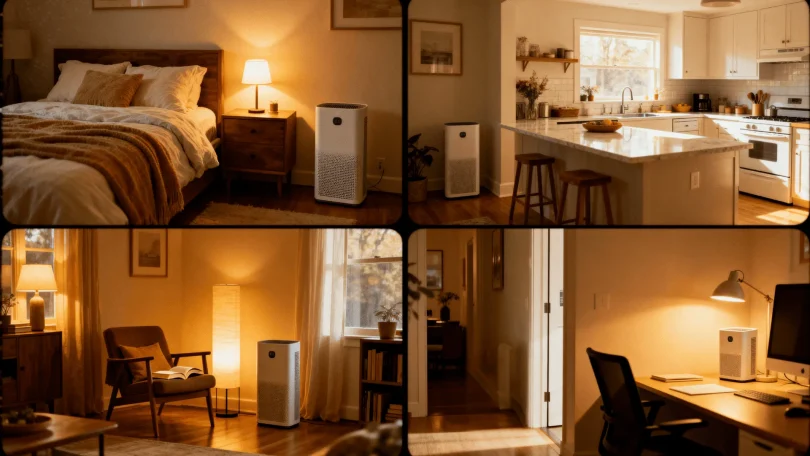

You purchased an air purifier. You plugged it in. But for some reason your indoor air still feels dusty or stuffy. We’ve all been there. The issue may not be your purifier. It may be how you’ve positioned it.
Believe it or not, placement is critical. When positioned correctly, an air purifier can quickly and efficiently reduce pollutants and contaminants in your indoor air. But if positioned poorly, your unit will use more energy and do little to improve your air quality. Finding that perfect spot in your home isn’t hard. First you just need to know what you should and shouldn’t do:
Contents
- 1 Pick the Right Room
- 2 Avoid Putting it in a Corner
- 3 Don’t Obstruct airflow
- 4 Place it Near Pollution Sources
- 5 Placement Tips for Bedrooms
- 6 Try Raising it Off the Ground
- 7 One Air Purifier per Room
- 8 Real World Example: Repositioning Air Purifier Improved Sleep Quality
- 8.1 Where should you not put an air purifier?
- 8.2 Should air purifiers face the window?
- 8.3 Do air purifiers help with allergies?
- 8.4 Can air purifiers cause congestion?
- 8.5 Should you sleep with an air purifier on?
- 8.6 Do air purifiers use a lot of electricity?
- 8.7 Should air purifiers be on all the time?
- 8.8 Should I leave my air purifier on with windows open?
- 8.9 Does an air purifier help with odors?
- 8.10 Is it better to have 1 air purifier or 2?
- 8.11 Do air purifiers make dust worse?
- 8.12 Should Air Purifiers Be Close To Bed?
- 8.13 Which is better: a central air purifier or corner?
Pick the Right Room
Before you think about where to put an air purifier in a room, think about where it would be most useful throughout your home. While every room can benefit from an air purifier, the biggest culprit in most homes is the bedroom.
Not only do you sleep in your bedroom for seven to nine hours each day, but you also breathe that air all night long. If you suffer from allergies, asthma, or any kind of respiratory issues, your bedroom is where an air purifier can most improve the quality of your air and your sleep.
The next most important room in any home is the living room. Typically larger than your bedroom, it’s used more often and accumulates more dust, pet hair, and airborne pollutants throughout the day.
Next, look for rooms where pollutants gather the most. Bathrooms, kitchens, and laundry rooms all produce moisture, odors, and particles that indoor air purifiers can eliminate.
Avoid Putting it in a Corner
One of the biggest air purifier placement mistakes is putting it in the corner of a room. People tend to do this because they think it looks better or keeps the unit out of the way. However, corners have some of the poorest airflow in any room. When placed in the corner, your purifier will struggle to push and pull air effectively. Instead, you’ll simply be filtering the same small portion of air over and over.
NationalHeaterShops told us that for best results, place your air purifier near the center of the room or against a wall with exposed space on either side. During one study, an air purifier placed in the center of the room improved air quality by about 71% in 10 minutes. The same unit placed in the corner only improved air quality by 63%. – https://www.youtube.com/watch?v=sQGfO4hNb60
Don’t Obstruct airflow
Air purifiers work by drawing air into the unit and filtering it out. In order for this to happen, you need to let your unit draw air freely. Every air purifier has air intake vents. Some have them on the sides. Some face the front or back. Some cylindrical models pull air from all angles. Regardless of how your air purifier looks, blocking the vents will affect its performance and may damage your unit in the long run.
Don’t shove your purifier into a tight cabinet or against furniture. Don’t stack papers or pillows on top of it. Give your air purifier at least one or two feet of free space around the vents. Think of it like a fan. A fan has better airflow when it’s not trapped in a corner. The same rule applies to air purifiers.
Place it Near Pollution Sources
If you know where dust, pollen, smoke, or pet dander accumulates the most in a room, move your air purifier near that source. In kitchens that means placing your purifier near the stove or wherever you mainly cook. Stove pollutants like smoke, grease particles, and cooking gases spread quickly throughout the kitchen. By placing your air purifier close to the source, it can catch those pollutants before they spread any further.
Pet owners should follow the same logic. If your cat lives in the laundry room with his or her litter box, move your air purifier nearby. If your dog sleeps on your couch, position your air purifier within a couple feet of his spot. You can even place the air purifier near where your pets walk and spend time so it filters their dander and hair along the way.
If someone smokes inside your home or near an open window, try placing your air purifier as close to them as possible. Secondhand smoke contains fine particles that can quickly spread throughout a room. Trying to stay ahead of the smoke helps.
Placement Tips for Bedrooms
The airflow in the bedroom is a little different. While you want the purifier close enough to clean your air, you don’t want it blowing directly into your face all night long. Strong airflow directly on you can lead to headaches. It can also dry out your eyes, nose, and throat.
Try moving your purifier a few feet away from your bed. Positioning it across the room or against a side wall usually works well. Just make sure it has open space around it and isn’t trapped in one spot. Always run your air purifier on a medium or low setting while sleeping to reduce noise.
Try Raising it Off the Ground
You’ll notice that most people place their air purifier directly on the floor. There’s nothing wrong with that and it works well for most families. However, if you have a smaller, less powerful air purifier, try elevating it a few inches. Air flow doesn’t just move horizontally throughout a room. It moves vertically, too. By placing your air purifier on a nightstand, shelf, or coffee table, you can elevate it closer to your breathing zone and potentially boost performance.
However, if you have a larger air purifier with powerful fans, placing it on the floor should be fine. Larger units already pull air in from several feet away and exhaust clean air several feet into the air. Elevating it won’t make much of a difference.
One Air Purifier per Room
Remember, air purifiers do not pull contaminants from all across your home down one central location. They simply clean the air that travels inside them. So if you want cleaner air throughout your entire home, you need more than one unit. Having one air purifier running in your living room won’t do much to improve air quality in your bedroom or home office down the hallway.
If you only have one air purifier, focus on the room you spend most of your time in. Your bedroom should be the priority. However, if you spend more time elsewhere, place it there instead. Once you experience the benefits, you’ll understand why it’s worth buying a second air purifier.
Real World Example: Repositioning Air Purifier Improved Sleep Quality
One family living in Seattle bought a portable air purifier to reduce seasonal allergy symptoms and dust accumulation in their bedroom. After running the purifier every day for several weeks they observed little to no change and continued to experience:
- Morning congestion
- Too much dust on their furniture
- Sneezing at night
- Awake several times during pollen season
They thought the air purifier was defective because their bedroom air quality did not get better. Initially, the purifier was positioned behind the bedroom headboard and a large bedside table because they didn’t want it to be visible or take up too much floor space.
THE PROBLEM
Blocked air intake vents Limited airflow due to corner location Clean air couldn’t flow throughout the room Dust and pollen remained stagnant around their bed.
THE SOLUTION
So they decided to optimize the location based on indoor air quality guidelines. They:
✔ Moved it about 1 metre away from walls and obstacles
✔ Placed it closer to the centre of the room
✔ Elevated the smaller air purifier on a bedside cabinet
✔ Kept doors shut while operating the purifier
✔ Ran the unit overnight on medium mode
✔ Maintained open space around all air intake vents
WHAT THEY NOTICED AFTER MOVING IT
Within a few weeks they started to see:
Less dust accumulating on furniture around the bed Less congestion and sniffling at night Better airflow throughout their bedroom Sleeping better at night during pollen season Didn’t have to run it on high just for better results
It seemed that moving their air purifier made more of a difference than simply running it on higher speed.
Studies have found that centre-location versus corner-placement can also impact air purifier effectiveness. One study concluded that air purifier placement did matter when it came to particle reduction. The difference was noticeable when the airflow around the appliance was restricted vs. open.
Summary
Adjusting the placement of your air purifier can have a big impact on your indoor air quality. Air purifiers work best when:
- Air can freely move in and out of the unit
- Particles are easily pulled into the air vents
- The air in your bedroom is being cleansed properly
- Your allergies are managed at night while you sleep
- Your air purifier operates at its maximum efficiency rating
Do not place air purifiers in corners, against walls or behind furniture where airflow is blocked. Learn more about air purifier placement.
Source / References: https://www.eurovent-certification.com/en/category/article/air-purifiers-help-allergies?universe=air-quality-and-ventilation
FAQ:
Where should you not put an air purifier?
Avoid corners and walls where possible. It’s best if the air purifier can sit in an open area and pull in pollutants from every direction. Don’t put it directly next to a window either.
Should air purifiers face the window?
Air purifiers should not face windows or doors. They should face into open space to allow pure air to flow out.
Do air purifiers help with allergies?
Air purifiers can help reduce allergy symptoms by filtering out airborne allergens. Consider getting a purifier that can handle the square footage of your space and frequently filter out particles.
Can air purifiers cause congestion?
Air purifiers do not cause congestion. In many cases, they can actually help relieve congestion caused by allergies and irritants.
Should you sleep with an air purifier on?
Yes. Air purifiers are great to have on at night while you sleep. They help remove allergens, dust, and dust mites from your breathing air.
Do air purifiers use a lot of electricity?
No, air purifiers do not use a lot of electricity. However, units with larger rooms will require more energy to clean the air.
Should air purifiers be on all the time?
It’s okay to leave your air purifier on all day and night. They are safe for you and your family, and most are quiet enough that you can sleep while they’re on.
Should I leave my air purifier on with windows open?
No. While it may be beneficial for your air purifier to run while you’re at home, leave it off when windows are open or if you will not be in the room for extended periods of time.
Does an air purifier help with odors?
Air purifiers help reduce unpleasant odors in your home. Look for air purifiers with an activated carbon filter to help absorb odors.
Is it better to have 1 air purifier or 2?
Having two air purifiers running at the same time will clean your home’s air twice as fast. One in each room where you spend the most amount of time is ideal.
Do air purifiers make dust worse?
No. Air purifiers do not make your home dustier. Dust will always find its way into your home but using an air purifier can help capture airborne dust.
Should Air Purifiers Be Close To Bed?
Air purifiers are great to keep near your bed while you sleep. Just don’t sleep right in front of the air blowing out. Learn more about where to put an air purifier and your bed.
Which is better: a central air purifier or corner?
Central air purifiers work better when they have airflow on all sides. Don’t place them in corners or block the air vents on the unit.