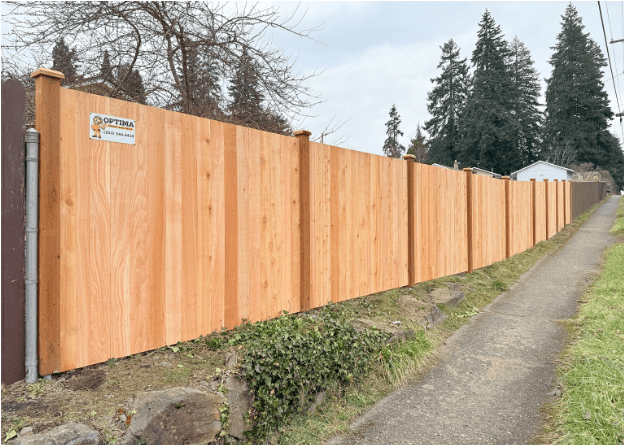

Drive through any established neighborhood in Bellevue and you’ll notice that cedar dominates the residential fencing landscape. Somerset backyards. Bridle Trails property lines. Newcastle side yards stepping down slope. The warm, natural tones of cedar board fencing are as characteristic of the Eastside as Douglas fir trees and gray winter skies.
Cedar fence in Bellevue, WA isn’t popular by accident. It’s popular because cedar — specifically Western red cedar — has natural properties that make it genuinely more appropriate for the Pacific Northwest climate than virtually any other wood species available. But the homeowners who discover their cedar fence failing after ten years often made the same few preventable mistakes in selection or maintenance. Understanding what makes cedar the right choice, and what it takes to make that choice pay off, is worth knowing before you commit to a new cedar fence.
Contents
What Makes Western Red Cedar the Right Fencing Wood for Bellevue
Natural Rot Resistance Built Into the Wood
Western red cedar contains oils called thujaplicins — natural compounds that inhibit the growth of the rot fungi and insects that destroy other wood species in wet conditions. This isn’t a treatment applied to the surface; it’s inherent in the wood itself. In Bellevue’s climate where rot pressure on wood structures is constant through the long wet season, this natural resistance is the foundation of cedar’s durability advantage.
The oils are most concentrated in the heartwood — the darker, denser core of the cedar tree. Clear heart cedar, which is vertically grained and primarily heartwood, has the highest natural oil content and the best durability profile for Bellevue fencing. Lower grades with more sapwood have significantly reduced natural rot resistance and should be treated with preservative to compensate.
Dimensional Stability in PNW Humidity
Cedar absorbs and releases moisture more gracefully than most other wood species. Its cellular structure handles the seasonal swelling and shrinking from Bellevue’s wet-dry cycle without the warping, twisting, and cupping that less dimensionally stable species experience. Cedar fence boards in a properly installed Bellevue fence hold their shape through multiple wet seasons without developing the gap-and-buckle pattern that characterizes poorly specified wood fencing.
Dimensional stability matters particularly in areas like Kirkland and Redmond where temperature and humidity swings during spring and fall transition seasons are significant. Cedar handles these swings better than alternatives.
Cedar Grades and What They Mean for Bellevue Fencing
Clear Heart: The Premium Choice
Clear heart cedar is vertically grained, free of knots, and primarily heartwood. It has the highest thujaplicin content, the best dimensional stability, and the most consistent appearance. For a Bellevue cedar fence that’s prominently visible — a front yard fence in Sammamish, a fence along the main yard in Newport Hills — clear heart is the grade that delivers the appearance and longevity the investment deserves.
The cost premium over lower grades is real. For homeowners planning to be in the home long-term, it’s well justified by the extended service life.
Common Grades and Their Trade-offs
#1 and #2 common cedar grades have more knots and more sapwood than clear heart. The sapwood — the lighter-colored outer wood — lacks the natural oil content that makes heartwood rot-resistant. A fence built from common-grade cedar with significant sapwood content in Bellevue’s wet climate needs more diligent maintenance and has a shorter effective service life than a clear heart fence.
Common grades are appropriate where budget is the primary constraint, provided the homeowner understands that more frequent maintenance and shorter replacement intervals are part of the trade-off.
The Maintenance Cedar Requires in Bellevue
Why Sealing Is Not Optional in the PNW
Cedar’s natural oils are durable but they do weather over time — UV from sunlight breaks down the surface, rain leaches oils from exposed wood, and the natural oils deplete gradually without replenishment. Unprotected cedar turns gray — a process called silvering — and becomes more moisture-permeable as the oils deplete.
Periodic sealing or staining slows this depletion, preserves the oils in the wood, and dramatically extends the service life of a Bellevue cedar fence. A penetrating oil-based stain or sealer applied every two to three years is the right maintenance interval for Bellevue’s climate. Product matters — cheap acrylic deck sealers film over the surface rather than penetrating the wood, peel in PNW conditions, and actually trap moisture below the surface film.
Annual Inspection for Moss and Soft Spots
Spring is the right time to inspect a Bellevue cedar fence — the wet season is ending, any moisture damage that developed through winter is at its most visible, and any soft spots that probe with a screwdriver are findable before dry summer conditions firm them back up. Catching early rot in one board before it spreads to adjacent boards is the maintenance catch that prevents a one-board problem from becoming a section replacement.
Moss removal every spring — a simple spray-and-rinse with a diluted wood cleaner — prevents moss from holding moisture against the cedar surface through subsequent wet seasons.
Optima Fence and Deck installs cedar wood fencing in Bellevue and throughout the Eastside — Kirkland, Sammamish, and Redmond — with material specifications and installation details that give Bellevue cedar fences the service life the material is capable of delivering in PNW conditions.
Frequently Asked Questions
Why does cedar turn gray on Bellevue fences so quickly?
The gray color is natural weathering — UV from sunlight and rain leach the natural oils from the surface and cause the wood fibers to oxidize. It’s not rot, and it doesn’t indicate structural failure. Applying a penetrating oil stain or sealer before the cedar weathers slows the process significantly. Bellevue’s cloudy climate actually accelerates UV-related weathering less than sunny climates, but rain leaching of surface oils happens continuously through the long wet season.
How often should I stain or seal my cedar fence in Bellevue?
Every two to three years is the right maintenance interval for Bellevue’s climate. Use a penetrating oil-based product rather than a film-forming acrylic — penetrating products protect the wood from the inside and don’t peel. Spring application — after the wet season ends and before summer heat — is the ideal timing because the wood is clean after the wet season and will absorb sealers well in moderate temperatures.
Can I pressure wash a cedar fence in Bellevue?
Light pressure washing removes moss and surface dirt effectively. Use low pressure settings — high pressure can raise the wood grain and damage the surface. Allow the fence to dry fully (at least several days of dry weather) before applying any sealer or stain after washing. Kirkland and Redmond’s spring weather can make finding a dry application window tricky — plan for the window when Bellevue gets its consistent May dry stretch.
What’s the difference between cedar and pressure-treated lumber for Bellevue fencing?
Cedar’s natural rot resistance comes from inherent oils; it looks and feels like natural wood and takes stain beautifully. Pressure-treated lumber has chemical preservatives forced into the wood under pressure — it’s more rot-resistant at grade level and below but has a greenish tint, is harder to work with, and takes longer to dry for finishing. For above-ground fence boards, cedar is the superior choice. For fence posts going into Bellevue’s wet ground, pressure-treated is the right specification.
Is cedar fence worth it over vinyl in Bellevue, WA?
For homeowners who value the natural appearance of wood, the warmth of cedar, and don’t mind a maintenance cycle, cedar is absolutely worth it in Bellevue. For homeowners who want zero maintenance and don’t prioritize the natural wood aesthetic, vinyl may be a better fit. Cedar at higher grades with proper maintenance typically outlasts low-grade vinyl, but quality vinyl outlasts neglected cedar. The honest answer depends on the homeowner’s priorities and willingness to maintain.