
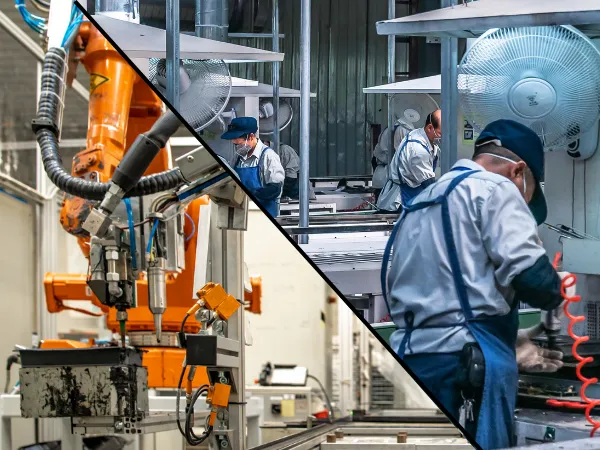

Small and mid-sized manufacturers used to automate last. Big plants had the capital and the volume to justify robotics; smaller shops relied on skilled workers who could adapt to a dozen different jobs in a single week. That divide is closing fast, driven as much by the shrinking pool of available skilled labor as by the push to cut production times, and it’s reshaping what work looks like on the factory floor of a typical SME.
Contents
Why SMEs held off on automation
Automation has always made the most sense at high volume, where a machine’s cost is spread across thousands of identical parts. Most SMEs run the opposite model: high-mix, low-volume production, often built around whatever an owner-operator or a handful of skilled tradespeople know how to do. Reprogramming a robot for a new job every few days used to cost more than just paying a person to adapt on the fly.
What’s changing now
Even according to Arcos srl, a company that produces robotic machines, three shifts are pushing SMEs toward automation faster than the volume argument alone would suggest.
- Labor is harder to find than it is to afford. Even shops willing to pay well are struggling to fill welding, machining, and finishing roles as experienced workers retire and fewer young people enter the trades.
- Automation has gotten easier to reprogram. Vision-guided robots, simpler programming interfaces, and off-the-shelf cells mean a machine can now be reconfigured for a new part in hours instead of days, closing the gap that used to favor manual work.
- Financing has caught up. Robotics-as-a-service, leasing models, and smaller collaborative robots have lowered the upfront cost that used to put automation out of reach for a shop with a handful of employees.
How the job mix is shifting
Automation in an SME rarely means replacing a whole department. More often it means one or two machines take over the most repetitive or physically taxing tasks, while the people who used to do that work move into roles that are harder to automate: quality control, machine tending, programming, and handling the custom or one-off jobs that still make up a large share of SME business.
This changes hiring more than it eliminates it. Shops increasingly look for workers who can operate and troubleshoot equipment, not just run it by hand, and that’s a different skill set than the one many experienced tradespeople were trained in.
The tension this creates
Not every worker wants to become a robot operator, and not every SME can afford to retrain its whole workforce at once. Owners often describe a real tension between two goals: keeping experienced people who know the business, and adopting technology those same people may resist or struggle to learn. There’s no universal answer, and the shops that manage this transition well tend to treat it as a gradual handoff rather than a sudden switch.
What this means for the job market
For workers, the practical path forward is less about competing with automation and more about learning to work alongside it. For SMEs, the calculation has shifted from “can we afford to automate” to “can we afford not to,” not just to speed up production, but because finding people to fill these roles by hand is getting harder. The result is a job market that isn’t shrinking so much as changing shape, with fewer purely manual roles and more hybrid ones that blend hands-on skill with basic machine literacy.