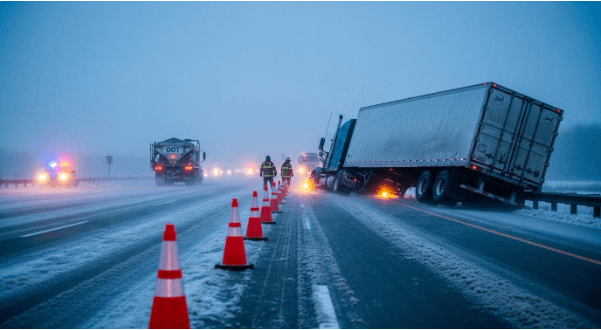

Flashing emergency lights, swirling snow, and miles of gridlocked traffic. It’s a scene playing out with alarming frequency across the Northeast and Midwest this winter, as jackknifed semi-trucks turn major interstates into parking lots.
A recent stretch of severe weather has triggered a dangerous spike in commercial truck accidents, leaving highways blocked for hours and stranding commuters in brutal cold. Here’s a look at the most notable incidents, the science behind these crashes, and what safety officials want you to know before your next winter drive.
Recent Incidents Show How Widespread the Problem Is
The latest round of storms hasn’t just caused fender-benders. Jackknifed semis have been the main culprit behind massive, hours-long highway shutdowns. And these aren’t isolated events; they’re popping up across multiple states almost simultaneously.
Chaos on the Massachusetts Turnpike
One standout example occurred on the Massachusetts Turnpike, where an Amazon trailer jackknifed during the morning rush. The wreck unfolded on the westbound side in Westborough, and emergency crews got one person to a local hospital with non-life-threatening injuries. But the real fallout? Traffic was snarled for hours, proving how one truck in the wrong position can shut down an entire corridor.
I-94 in Michigan Faces Gridlock
Michigan got hammered, too, especially on Interstate 94. A jackknifed semi closed westbound I-94 in Berrien County, triggering massive delays. The Michigan Department of Transportation issued alerts while state police worked to clear the scene near Red Arrow Highway. Reported around 10 a.m., the closure took several hours to resolve, with traffic rerouted and gridlock spreading throughout the region.
A Pattern Across the North
Massachusetts and Michigan aren’t alone. In Connecticut, a truck jackknifed in Berlin, rupturing its fuel tank and forcing the state’s Department of Energy and Environmental Protection to manage the spill.
Out in Washington, icy conditions on I-90 near Snoqualmie Pass caused a jackknifed semi and a full highway closure. Coast to coast, winter weather is making this a national problem.
What Actually Causes a Jackknife?
So what’s going on when a massive truck folds in on itself? It’s a mix of physics, weather, and human decision-making, and understanding those factors is the first step toward preventing these wrecks.
The Physics of Losing Control
A “jackknife” occurs when a semi’s trailer loses traction and swings out at a sharp angle from the cab, resembling a folding pocketknife. Usually, it starts when the tractor’s drive wheels lock up during braking, causing them to skid. The trailer wheels, still rolling with their own momentum, keep pushing forward. That force shoves the trailer sideways, creating the uncontrolled pivot that turns into a full jackknife.
Weather as the Trigger
The weather is the biggest factor behind this recent wave of crashes. Icy roads, black ice, and sudden wind gusts create conditions where traction practically disappears. Reports from the Connecticut incident specifically named black ice as a major cause, while other crashes involved a combination of high winds and slick pavement.
These conditions reduce friction between the tires and the road surface. That makes it shockingly easy for a driver to lose control during what would normally be routine braking or a simple lane change.
Other Contributing Factors
Bad weather is often the immediate trigger, but it tends to expose deeper problems. There are several common jackknife truck accident causes that turn a tough situation into a catastrophe, from unbalanced cargo to poor driver training. Here are some of the most critical ones:
- Excessive speed: Driving too fast for conditions is a persistent problem. In 2022, speeding was a factor in 21% of fatal crashes involving large trucks.
- Improper braking: Slamming the brakes on a slick surface can lock the wheels instantly, triggering a skid that can lead to a jackknife. Drivers are trained in specific techniques to avoid this, but in a panic, instinct often wins.
- Mechanical failure: The truck’s condition matters enormously. According to the FMCSA, brake problems factored into 30% of large trucks involved in crashes. Worn tires that can’t grip the road are another major risk.
- Driver error and fatigue: Human factors are often the deciding element. The FMCSA’s Crash Causation Study found that driver error was the critical factor in 87% of truck crashes. On top of that, fatigue accounts for about 13% of incidents, significantly slowing reaction times when conditions become hazardous.
The Ripple Effect of a Single Crash
One jackknifed truck doesn’t just block a lane. It creates a domino effect of delays, economic costs, and secondary dangers that can ripple across an entire region for hours.
Delays and Economic Impact
When a semi blocks an interstate, the consequences are immediate. A crash on Highway 401 blocked all express lanes, causing miles-long backups that persisted for hours. An Eisenhower Expressway jackknife in Chicago shut down lanes during the morning commute.
These aren’t just inconveniences. They carry real economic costs: lost productivity, wasted fuel, delayed shipments, and disrupted supply chains that hit local economies hard.
Spills and Pile-Ups
Beyond traffic jams, jackknifed trucks bring other serious hazards. The Connecticut crash showed how a ruptured fuel tank can demand specialized environmental cleanup. But the bigger nightmare? Multi-vehicle pile-ups. When drivers behind the initial wreck can’t stop in time on slick roads, a single incident can escalate into a chain-reaction crash involving dozens of vehicles.
Staying Safe Around Trucks in Winter
Given the risks, the Department of Transportation and other safety agencies have clear advice for anyone sharing the highway with commercial trucks in winter. The single most important thing you can do is increase your following distance. A truck’s stopping distance is already far longer than a car’s, and ice and snow magnify that gap dramatically.
Here’s how to think about spacing in different conditions:
| Road Condition | Recommended Following Distance | Why It Matters Near Trucks |
|---|---|---|
| Dry/clear | 4-5 seconds | Keeps you out of blind spots; gives time to react to sudden braking |
| Wet/rainy | 6-8 seconds | Trucks spray water that kills visibility; stopping distances increase significantly |
| Icy/snowy | 10+ seconds | A truck may need a football field’s length to stop |
| High winds | Add extra space | Gusts can push a trailer sideways into your lane without warning |
The Bottom Line
These recent storms have been a harsh reminder of just how vulnerable major interstates are to jackknife accidents. The incidents in Massachusetts and Michigan show how quickly widespread disruption can unfold. And while severe weather is the most obvious culprit, factors like excessive speed, poor vehicle maintenance, and driver fatigue play huge roles in turning bad conditions into deadly ones.
Understanding the risks is half the battle. Practicing defensive driving, keeping your distance from trucks, and knowing when to simply stay off the road can make the difference between getting home safe and becoming part of the next traffic nightmare.
Frequently Asked Questions
Q: What exactly is a “jackknife” accident?
A: It’s when a semi-truck’s trailer drags out to the side of the cab, forming a sharp V-shape like a folding knife. This typically happens when the tractor’s wheels lose traction and skid while the trailer continues to move forward.
Q: Why are jackknife accidents more common in winter?
A: Ice, snow, and slush drastically cut tire traction. That makes it far easier for a truck’s wheels to lock up during braking or lose their grip, which is the primary trigger for a jackknife.
Q: How often do these accidents happen?
A: According to the FMCSA, jackknifing is involved in roughly 3.5% of all fatal truck accidents and occurs in about 5% of all commercial truck crashes.
Q: How much space should I give a semi-truck in bad weather?
A: In icy or snowy conditions, leave at least 10 seconds of following distance. That extra buffer accounts for trucks’ much longer stopping distances and gives you time to react if something goes wrong.
Q: Can high winds cause a truck to jackknife?
A: Absolutely. Strong crosswinds can push against the large, flat surface of a trailer, causing it to sway or lose traction. If the driver overcorrects or if the road is also slick, a jackknife can happen fast.
Q: What should I do if I see a jackknifed truck ahead?
A: Slow down immediately and safely. Switch on your hazard lights to warn drivers behind you. Look for a safe place to pull over or an exit. Don’t try to drive around the accident unless emergency personnel direct you to do so; the scene may be unstable.