
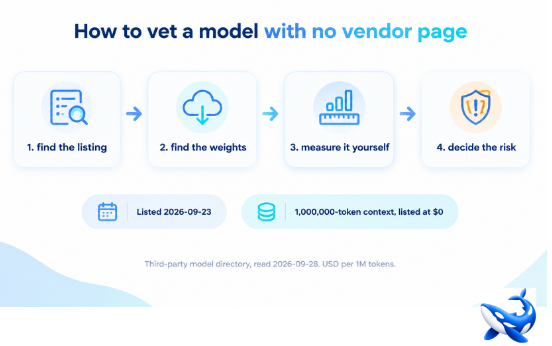

Most model evaluations assume a document exists. There is a product page, a model card, a pricing table, a benchmark row — and the work is reading them. The entry added to the directory on 23 September 2026 breaks that assumption: an anonymous model, free to call, with a million-token context and adjustable reasoning tiers, and no vendor page at all. It is one of the more interesting entries in this month’s new AI model releases precisely because it is the hardest to check, and because the honest answer to “is it any good” is that nobody outside the directory has said. On OrcaRouter every row in the catalogue of new ai model releases is something you can call, so it is worth asking what can and cannot be established about one that arrives without paperwork.
Contents
What the listing actually gives you
Three facts, and they are the whole public record.
It appeared on 23 September 2026. Its context window is 1,000,000 tokens, which puts it in the top tier of this batch rather than the middle. And its price field reads $0 and $0.
That last one deserves care, because a zero in a price column is ambiguous. It can mean the model is free, or it can mean nobody has recorded a price. Elsewhere in this same batch there is a model whose price fields are also zero, and in that case the correct reading is “no price recorded” — the model is a commercial product whose rate simply is not in the dataset. Here the listing describes the model as free and the surrounding description treats it as free, so free is what we take it to be. The general lesson is not to assume: a zero is a number and it is also a blank, and the two look identical in a table.
Everything else — the architecture, the parameter count, the training data, the licence — is unstated.
Why a stealth entry exists at all
Anonymous models appearing in callable catalogues are usually one of three things, and the listing does not tell you which.
The first is a pre-announcement evaluation: a lab puts a model into the wild under a neutral name so that developers can use it and report back before anything is branded. In that case the anonymity is temporary and the model will reappear with a name attached.
The second is a deliberate test of whether quality or branding drives adoption — a controlled experiment where the same weights are released under two identities.
The third is a compliance or licensing avoidance, which is the one to be careful about. A model that no one will put a name on is a model whose provenance you cannot establish, and provenance determines whether you may use its outputs commercially, whether you can ship the weights, and what happens if a rights holder objects.
The listing is consistent with the first two and cannot rule out the third. That is not an accusation; it is the actual state of the evidence.
What you can measure without any vendor
This is where the absence of a vendor page stops mattering, because the things you care about most are measurable from the endpoint itself.
Latency you can measure trivially: send a fixed workload and record the distribution, not the mean. Instruction-following you can measure with any held-out eval set you already own. Tokenisation you can measure by sending a known string and comparing the reported token count against your current provider’s count for the same string — a mismatch there is a silent cost multiplier, and it is the single most common surprise when switching to a model with no published tokenizer.
Reasoning-tier behaviour you can measure by running the same prompt at each setting and recording both the answer and the token count. A tier that changes the answer is a capability setting. A tier that changes only the number of tokens and the latency is a verbosity setting. Those are different products, and the distinction is usually undocumented even when a vendor page exists.
The one thing you cannot measure is where the data goes. That requires documentation, and the absence of a vendor page is exactly the absence of that documentation.
The risk question, in the right order
Ask these in order, because the answer to the first can make the rest irrelevant.
Does it touch data you would not send to an unidentified endpoint? If yes, stop. The free price is not worth a data handling question you cannot answer, and there is no amount of evaluation that resolves it.
Does it need to be reproducible? An anonymous model can change or vanish without notice, and a system that depends on it has an undocumented single point of failure. If you would not accept that in a dependency you pay for, do not accept it because it is free.
Does the licence survive contact with your product? Without a vendor page there is no licence to read, which for anything shipped to customers means the safe assumption is the most restrictive one.
Only after those three does capability matter — and capability is the part you can actually test.
The free-model trap for the other direction
There is an inverse error worth naming, because coverage of free models tends to make it: assuming that free means either worthless or a windfall.
Free is a price, not a quality signal in either direction. A lab that releases a model at zero cost is buying adoption data, or stress-testing capacity, or building a reputation — all legitimate and all consistent with a good model. Equally, a free model may be a preview whose quality is deliberately not final. The price tells you who is paying, not how good it is.
The right posture is the one you would take toward any new dependency: measure what is measurable, refuse to guess at what is not, and keep the blast radius small until either documentation appears or the model has been in enough people’s hands long enough that the absence of documentation is itself informative.
What this release says about the calendar itself
The reason this model is hard to write about is the reason it belongs in a round-up. A release calendar sorts by date and assumes that every row is comparable; the rows arrive with wildly different amounts of supporting material. Some come with a vendor, documentation, weights and an independent score. Others come with a timestamp, a context length and a price.
Sorting by the date a model became callable, rather than the date a press release went out, makes that variance visible immediately. It also explains a discrepancy that shows up across this batch: a model’s own recorded release date and its first appearance in a callable catalogue can be months apart, because shipping a news post and shipping an endpoint are different events. For anyone whose question is “what can I call today”, the catalogue timestamp is the useful one — and for a model like this one, it is the only date there is.
Sourcing note: This model’s listing date of 23 September 2026, its 1,000,000-token context window, its ability to be called at adjustable reasoning settings, and the $0 and $0 values in its price fields were read from a third-party public model directory on 28 September 2026 and are that directory’s figures. The reading of a zero price as free here, in contrast with another entry in the same directory whose zero price fields mean no price recorded, is our interpretation of the directory’s own description and is stated as such. The absence of any vendor page, model card, or independent index row for this model was our own check on 28 September 2026. The statement that the model is not in OrcaRouter’s catalogue is a statement about our own catalogue on 28 September 2026. The three possible explanations for anonymous catalogue entries, the measurement checklist, and the three risk questions are editorial framing and are not findings about this model. No evaluation result, parameter count, licence or index score is quoted because none is published. This article names no competing platform and describes none.