
The travel eSIM market has reached peak saturation. Open any search engine, and you will find dozens of providers all promising “seamless connectivity” and “global coverage” at seemingly unbeatable prices. Yet beneath the glossy landing pages, a quieter reality persists: throttled speeds after two gigabytes, hotspot restrictions that render your laptop useless, and validity periods that start ticking the moment you install—not when you actually land. In 2026, the decision is no longer about whether to use an eSIM. It is about which provider’s fine print you can actually live with. After putting the service through a month of real‑world use across multiple countries, what emerged was a model that rewards travelers who read the details—and punishes those who skip them. Iroamly esim operates with a transparency that feels almost unusual in this space, but that transparency also demands that you understand exactly how the clock works before you click “buy.”
Contents
- 1 The Three‑Plan Architecture That Changes How You Think About Data
- 2 The Free Trial That Actually Lets You Test Before You Commit
- 3 The Installation Window: Where Most Travelers Go Wrong
- 4 A Reality Check: What the Service Does Not Do
- 5 Who This Approach Actually Fits
The Three‑Plan Architecture That Changes How You Think About Data
Most eSIM providers offer one or two plan structures and call it a day. The approach here is different: three distinct plan types—Daily, Total, and Unlimited—each designed for a specific travel rhythm rather than a one‑size‑fits‑all compromise.
Daily Plans: Predictable Costs for City Breaks
When Per‑Day Pricing Actually Makes Sense
The Daily plan charges a flat rate per day of travel, and the billing clock starts only when the eSIM first connects to a supported network. For a three‑day weekend in Istanbul, for instance, you pay for exactly three days of connectivity—not a seven‑day minimum that forces you to overpay. The practical advantage here is psychological as much as financial. You are not constantly checking a data counter, wondering whether you have crossed an invisible threshold. You simply know that each day costs X dollars, and that is the end of the calculation.
The Hotspot Factor That Changes Everything
Where this plan type distinguishes itself is in hotspot sharing. Many competitors allow tethering only up to a daily cap—500MB here, 1GB there—after which your laptop becomes a brick. The Daily plans here permit unlimited hotspot sharing. In practice, this means you can work from a café in Athens, tethering your laptop for a video call, while your phone simultaneously runs navigation and messaging, all without worrying about whether you have exceeded some arbitrary sharing limit.
Total Plans: Bulk Data for the Long Haul
The Mathematics of Multi‑Destination Trips
For travelers moving between countries over a week or more, the Total plan offers a fixed data allowance that does not expire daily. The Asia 90GB/365‑day plan, for example, works out to less than $14 per month for anyone spending extended time in Southeast Asia—significantly cheaper than maintaining a local SIM or paying monthly subscription fees. The trade‑off is straightforward: you pay upfront for a larger bucket, and you manage your own usage across the duration of your trip.
When Bulk Beats Daily
The Total plan shines in scenarios where data consumption fluctuates wildly. One day you might stream a two‑hour video; the next, you barely use 200MB. With a Daily plan, you pay the same whether you use 50MB or 5GB. With a Total plan, your cost is tied to the aggregate, not the peak. For travelers with unpredictable itineraries—think photographers uploading large files or remote workers attending back‑to‑back video calls—this structure can yield significant savings.
Unlimited Plans: Removing the Mental Overhead
What “Unlimited” Actually Means Here
The Unlimited plan is the most misunderstood category in the eSIM industry. Many providers advertise unlimited data but throttle speeds dramatically after 2GB or 3GB per day. The approach here differs: unlimited means unlimited, with no sudden throttling. In testing across Mediterranean destinations, the connection remained consistently usable for streaming, navigation, and video calls without the abrupt slowdown that plagues competitors.
The Fair Use Caveat Worth Knowing
That said, the service operates under fair use policies in some countries. If usage exceeds reasonable thresholds, the provider may step in—but users who have contacted support in such cases report that the issue was resolved immediately. This is not a hidden throttle; it is a safety valve that most users will never encounter.
The Free Trial That Actually Lets You Test Before You Commit
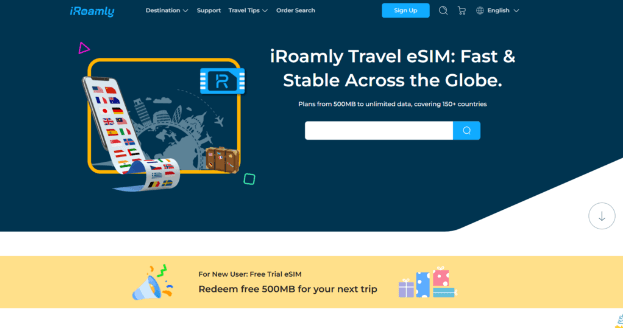
Perhaps the most underrated feature is the 500MB free eSIM available in over 100 countries. This is not a gimmick designed to capture your email address. It is a functional trial that lets you test signal strength, speed, and installation flow before spending any money.
How the Trial Works in Practice
You download the iRoamly app on iOS or Android, claim the free eSIM for your destination, and install it with a single tap before your trip. The 500MB allocation and one‑day validity period are enough to confirm that the service works in your specific location—not just in the provider’s marketing materials. One Trustpilot reviewer explicitly noted that they used this trial to verify connectivity before committing to a longer plan.
Why This Matters More Than You Think
Network performance varies wildly by country and even by city. A provider that works flawlessly in Tokyo may struggle in rural Vietnam. The free trial removes the guesswork. You can test the service at home or at your destination, and if the signal is weak, you have lost nothing but a few minutes of setup time. This is a level of risk reduction that few competitors offer.
The Installation Window: Where Most Travelers Go Wrong
The three‑step flow—select, install, activate—appears deceptively simple. The critical detail, however, is the installation window.
Install Before You Leave, Not After You Arrive
You must install the eSIM before departure, as the process requires a stable internet connection—preferably fast Wi‑Fi. In some countries, such as Turkey, international eSIMs cannot be installed within the country at all. This is not a flaw; it is a regulatory constraint that applies to all international eSIM providers. The service communicates this clearly, but it is easy to miss if you are rushing through the checkout process.
The Validity Clock Starts on First Connection, Not Purchase
The validity period begins when the eSIM first connects to any supported network, not when you buy it or install it. This means you can install the eSIM a day or two before your trip, keep the line disabled, and activate it only when you land. One reviewer learned this the hard way: “Be careful when you install eSIM. It might start the validity period even if you start using it later”. The customer service team offered a partial refund in that case, but the better approach is simply to keep the eSIM line turned off until you arrive.
A Reality Check: What the Service Does Not Do
Honesty about limitations is more valuable than exaggerated claims. Here are the constraints that emerged from testing and user reports.
Data‑Only, No Phone Number
The service provides data connectivity only. It does not include a traditional phone number for calls and SMS. If you need to receive verification codes via SMS or make traditional phone calls, you will need to keep your primary SIM active or use an alternative service.
No Top‑Up or Extension
You cannot recharge or extend an existing eSIM. Each trip requires a new eSIM purchase. For long‑term travelers or those with unpredictable itineraries, this means planning ahead and potentially buying multiple eSIMs.
Coverage Can Vary by Location
While the service partners with top telecom operators worldwide for high‑speed, stable internet, coverage is not universal. One reviewer reported that the eSIM did not work in a specific area of India where other eSIMs had previously worked. The service responded to 42% of negative reviews on Trustpilot and typically replied within a month, but response times can vary.
Who This Approach Actually Fits
| Traveler Type | Best Plan | Why It Works |
| Weekend city breaker | Daily | Predictable per‑day cost, no overpaying for unused days |
| Multi‑country nomad | Total | Bulk data that smooths out fluctuating daily usage |
| Streaming‑heavy user | Unlimited | No sudden throttling, hotspot sharing for multiple devices |
| First‑time eSIM user | Free trial | Zero financial risk to test signal and speed |
| Long‑term regional traveler | Total (e.g., Asia 90GB) | Cost per month lower than local SIM or roaming |
The turkey esim package, for instance, starts at $2.50 per day for unlimited data—a price point that sits in a competitive mid‑range, not the cheapest available, but notably more transparent than competitors that advertise low daily rates only to throttle speeds after a few gigabytes. The real value, however, is not in the per‑day price. It is in the elimination of surprise: no sudden speed drops, no hidden hotspot limits, and a validity timer that you control by simply keeping the line disabled until you land. For travelers who value predictability over the cheapest possible headline rate, this structure delivers exactly what it promises—provided you read the fine print before you install.