
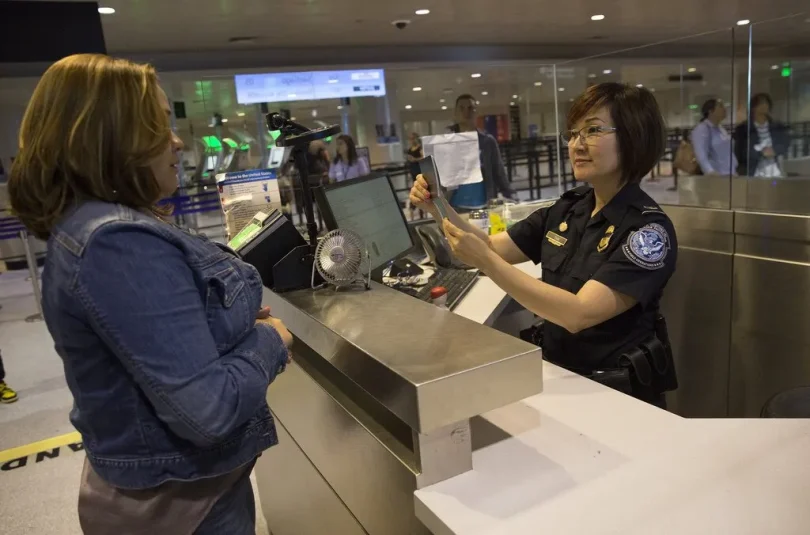

The federal agents at Newark airport took the traveler’s phone and demanded the password. They searched its contents without a warrant, then made an electronic copy they could examine long after the device was returned. Weeks later, investigators obtained a warrant to search that copy and used information from the phone to pursue evidence in a domestic criminal investigation unrelated to the border crossing.
The traveler was Jatiek Smith. An EFF case writeup describes how a phone search during his return from Jamaica became part of a federal extortion prosecution. The dispute raised a question that federal defense attorneys and others handling digital evidence must confront: how far can the government use information collected under the border-search exception when the investigation has no apparent connection to international travel?
Contents
The Border Exception Was Built for Suitcases, Not Phones
Federal officers have long been permitted to inspect luggage and other property at international borders without the warrant ordinarily required for a search. Courts have extended aspects of that authority to electronic devices, although they disagree about the constitutional limits.
A basic device search generally involves an officer manually reviewing information stored on a phone, tablet, or computer. An advanced search uses external equipment to copy, review, or analyze the device’s contents. The difference is significant because forensic tools may preserve information for examination after the traveler leaves.
Under CBP’s electronic-device search policy, advanced searches generally require reasonable suspicion of a violation of laws the agency enforces or a qualifying national security concern, along with supervisory approval. Those policy requirements are separate from the constitutional standards courts apply, which vary by jurisdiction.
What a Forensic Copy Takes With It
A forensic extraction can preserve substantial amounts of information, potentially including messages, photographs, contacts, documents, and other data stored on the device. The scope depends on the extraction method, the device’s security protections, and what information was accessible during the search.
CBP policy permits retention of certain information obtained through border searches when specified enforcement-related conditions are met. Retained information may be stored in the agency’s Automated Targeting System, with retention periods that can extend up to 15 years or longer when records remain connected to qualifying law enforcement activity.
Not every device search produces a complete forensic image, and not every extraction is automatically uploaded to a broadly accessible database. Access and sharing are governed by agency policies and applicable legal requirements. Still, information retained after a border inspection may become relevant to investigations conducted elsewhere.
Smith’s Copy Turned Up Far From the Port of Entry
Smith was stopped at Newark Liberty International Airport on March 2, 2021, while returning from Jamaica. Federal agents searched his phone and created a copy of its contents without obtaining a warrant. According to the district court’s account, investigators began examining the copied information before later obtaining judicial authorization to search it.
The government subsequently used evidence connected to the phone in an investigation involving alleged extortion and other conduct unrelated to Smith’s international travel. Smith challenged the original search and sought to suppress evidence obtained directly or indirectly from it.
The dispute exposed two connected questions. First, could agents copy the contents of a phone at the border without a warrant? Second, could evidence derived from that search be used in a prosecution with no meaningful border connection?
The government’s later warrant did not automatically settle whether the original extraction was constitutional or whether evidence flowing from it should be admitted.
A 2023 Ruling Pushed Back, and the Appeal Followed
In May 2023, a federal district judge in the Southern District of New York concluded that the warrantless copying and search of Smith’s phone violated the Fourth Amendment. The court reasoned that the privacy interests associated with a modern cellphone required stronger protection than the traditional border-search exception provided in the circumstances.
But the ruling did not give Smith the suppression remedy he requested. The judge applied the good-faith exception, concluding that the evidence could remain admissible despite the constitutional violation.
Smith later appealed his conviction to the Second Circuit, where the border-search issue continued to receive attention. The case illustrates an important distinction between finding that a search violated the Constitution and excluding the resulting evidence from a criminal prosecution.
Federal appellate courts have taken different approaches to electronic-device searches at the border. The governing standard depends on the jurisdiction, the type of search, and the circumstances involved. A single district court ruling does not establish a nationwide warrant requirement.
Move Before the Copy Starts Traveling
For defense counsel, the immediate concern is identifying whether evidence in a domestic prosecution originated with an earlier border inspection. That connection may not be obvious from the charging document alone. Investigators could have relied on information from the phone to obtain later warrants, identify witnesses, or develop other evidence.
“The extracted image contains everything on the device at the moment the phone was taken,” say attorneys at SBBL Law. “The time to demand the forensic report and the chain-of-custody records is the moment a charging document hints at border-derived evidence, not the morning of trial.”
The precise scope of an extraction must be established through the forensic records rather than assumed. Defense attorneys may need the search authorization, extraction reports, chain-of-custody documentation, records of subsequent access, and applications for warrants obtained after the border encounter.
Those materials can help determine what investigators initially collected, when they examined it, and whether later evidence depended on an earlier search. Challenges to that evidence are subject to procedural deadlines, making early review especially important.
The phone may have been returned at the airport. The legal questions surrounding its copied contents can remain active long after the traveler gets home.