
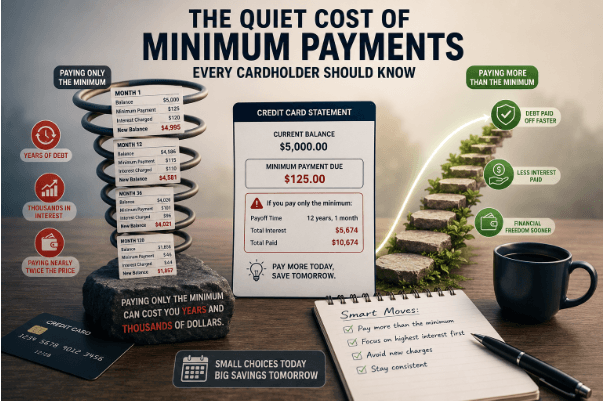

The minimum payment on a credit card statement is one of the most misunderstood numbers in personal finance. It looks helpful, almost generous, a small figure that lets you stay current and avoid a late fee even in a tight month. But that modest number hides a long and expensive story. Paying only the minimum is not a neutral choice that keeps things steady; it is a decision that quietly extends debt for years and multiplies the total cost of whatever you bought. Understanding exactly how this works is one of the most valuable pieces of financial literacy a cardholder can acquire, because the math is not intuitive and the card issuer has little incentive to explain it.
How the Minimum Is Designed to Work
A minimum payment is typically calculated as a small percentage of your outstanding balance, often somewhere in the low single digits, plus any interest and fees that have accrued. Because it is a percentage of the balance, the amount shrinks as the balance shrinks, which sounds reasonable until you trace the consequences. The lower your payment, the more of the balance survives into the next billing cycle, and the more of that balance survives, the more interest it generates. Interest, in turn, is added back to the balance, and the cycle repeats.
This is compound interest working against you rather than for you. When money compounds in a savings account, you celebrate. When it compounds on a revolving balance, it silently inflates the price of everything you charge. A purchase that felt affordable at checkout can end up costing far more than its sticker price by the time it is finally paid off, sometimes taking years to clear if you never pay more than the minimum. The structure is not an accident. It is designed to keep balances alive as long as possible, because an outstanding balance is precisely what generates revenue for the lender.
The Real-World Math Behind the Trap
Consider the shape of the problem without getting lost in specific figures. Imagine a balance carried at a typical card interest rate, with the cardholder faithfully paying only the required minimum each month and never adding new charges. In many realistic scenarios, the payoff timeline stretches over a decade, and the total interest paid can approach or even exceed the original amount borrowed. You would, in effect, be paying for the same purchase nearly twice, spread across years you will barely remember making the purchase for.
What makes this so insidious is that everything feels under control the whole time. The account stays in good standing. No collector calls. The credit score may even look fine. This calm surface is exactly why the cost stays quiet. People who would never agree to double the price of a purchase upfront routinely agree to it in slow motion, one minimum payment at a time. Because the anchor of the arrangement is that small monthly number, attention naturally drifts away from the growing total. In some markets, cash-advance and card-liquidation practices, sometimes referred to by the Korean term 신용카드 깡, add further layers of cost and complexity that make careful attention to card balances even more important. Wherever you live, the underlying principle holds: the longer a balance lingers, the more it costs, and minimum payments are engineered to make balances linger.
Breaking the Cycle
The escape route is straightforward in concept, if not always easy in practice: pay more than the minimum whenever you possibly can. Even a modest increase above the required amount has an outsized effect, because every extra unit of payment goes directly against the principal rather than being consumed by interest. Reducing the principal faster shrinks the base on which interest is calculated, which accelerates progress in a way that compounds in your favour for once.
A few practical habits help. First, treat the minimum as a floor, never a target. Decide on a fixed payment amount you can sustain and hold it steady even as the balance falls, rather than letting your payment shrink alongside the minimum. Second, if you carry balances on more than one card, direct extra money toward the highest-rate balance first while paying at least the minimum on the rest, which minimises total interest. Third, avoid adding new charges to a card you are trying to pay down, since fresh purchases reset your progress and blur the finish line.
Perhaps most important is simply to look at the full picture your statement offers. Many statements now include a disclosure showing how long the payoff would take at the minimum and how much it would cost, precisely because that number is so revealing. Reading it once, honestly, is often enough to change behaviour.
The minimum payment is a tool, and like any tool,l it can serve you or trap you depending on how you use it. Used as an occasional safety valve in a genuinely hard month, it does its job. Used as a habit, it becomes one of the most expensive routines in ordinary financial life. Knowing the difference and acting on it is what separates a balance that fades in months from one that follows you for years.