
AI is making it easier to fake reality. Deepfake videos imitate public figures, AI voices mimic musicians, actors and politicians, and edited images spread across social media before anyone checks if they’re real.
But Gen Z is craving authenticity. In fact, that was ranked as their most important value – beyond success and wealth – in a study commissioned by EY. Young people crave “in real life”, or IRL, experiences, and 92% are found to want in-person authenticity.
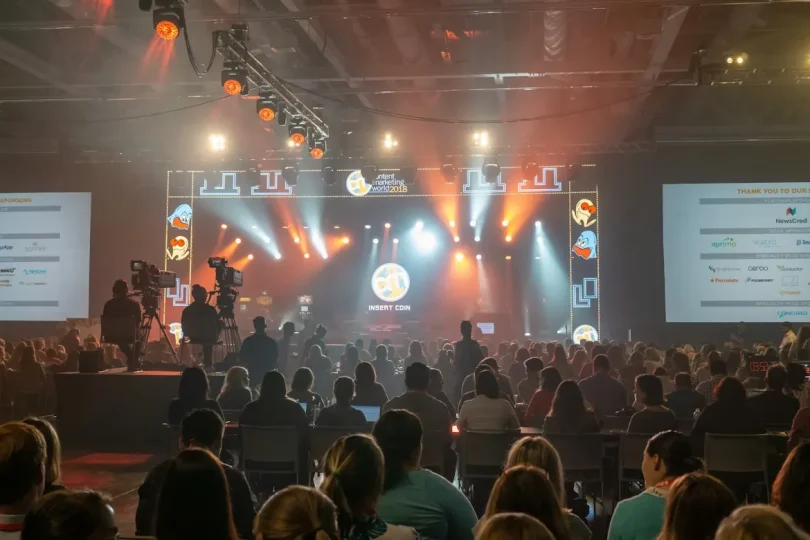
And platforms are pushing back on AI slop. YouTube and Meta have announced they’re demoting “inauthentic” content and preferencing human output. The Friday writer Dave Jackson described the unpleasant experience of slogging through AI-generated podcasts and AI-presenter-led videos. He is not alone in wanting something real. That desire is not just felt online, but in theatres, conferences, and music venues.
Live experiences gaining ground again
Live experiences are seeing renewed demand. Research into the experience economy shows a move away from passive consumption toward interactive and sensory events; North America dominates the immersive entertainment industry (per Grand View Research). The Immersive Entertainment Market (2026 – 2033) report notes the sector is expanding because audiences want more engaging, participatory formats rather than screen-based content alone – and they’re willing to pay more for it.
Surveys of immersive experience audiences, such as the one conducted by Gensler Research Institute and the Immersive Experience Institute last year, highlight that interactivity, emotional impact, and live performers are among the most valued elements of modern events. People travel and pay more for events that feel personal and immediate.
That has influenced everything from large-scale music tours to experimental theatre. Even stadium design is evolving, with venues increasingly built for mixed media, audience participation, and personalised experiences.
AI content changes how audiences judge authenticity
The rise of AI-generated media has changed expectations around live entertainment. Deepfake videos, synthetic music, and AI-assisted performances make it harder to assume that what appears on a screen reflects real human activity.
AI is now widely used in production (of all media). A large share of music professionals report using AI tools in creative processes (87%, according to Landr research), from sound design to stage visuals. This has blurred the boundary between human and machine-made content.
But that has made physical presence more meaningful for many audiences. When digital content can be generated instantly, the value of shared space and real-time performance increases.
Music and theatre
John Dante Prevedini has written that the widespread debate of AI in music tends to miss the important question. We should not be asking whether it can play or write a good piece of music, but how we can seek out and verify the humanity – the “flesh-and-blood, vulnerable and mortal dimensions of human consciousness” – of a composition. His conclusion, despite the challenges in the industry, was that music will survive AI because humans naturally enjoy using sound to express themselves and communicate with each other. And people still love experiencing live music and human movement: writer and professional musician Natasha Sachsenmeier has written of the power of hearing the “slight bite” of a string before the note blooms; seeing a conductor giving the upbeat at the start of a symphony; and being there in the flesh, in the moment to witness live music.
Mentalists and the wider live experience trend
Speciality performers such as mentalists continue to attract attention. A well-constructed mentalist show is built around live audience participation, observation, and psychological performance techniques. It depends entirely on timing, human reaction, and shared physical space – things which AI cannot address.
Mentalism sits alongside immersive theatre, live music, and interactive exhibitions as part of an interest in experiences that can’t be replicated through screens. What makes it relevant in the current age is not necessarily the idea of “mind reading”, which in reality is a clever combination of psychological reading and subtle suggestion, but the live structure of the performance. The audience sees everything unfold in real time, without editing or digital reconstruction.
Real-world presence amid digital saturation
As AI-generated media becomes more common, audiences are responding in different ways. Some embrace digital tools, while others look for balance through live events that feel grounded in physical reality. Even with advances in virtual reality, augmented reality, and AI content, physical presences, creations and connections are still thriving.