
A loose electrical connection doesn’t announce itself. It just gets warmer. Quietly, over days or weeks, until one day it fails and takes a circuit, or a whole line, down with it. A bearing losing lubrication behaves the same way. So does a section of pipe insulation breaking down somewhere it can’t be seen. None of these make noise early on. None of them look broken. What they do is generate heat, and that’s the one thing thermal4 imagers are built to catch.
Contents
- 1 What a Thermal Imager Does
- 2 Why Waiting for Equipment to Fail Costs More
- 3 Where Thermal Imaging Catches Problems Early
- 4 Portable vs Online Thermal Imaging Systems
- 5 What to Look for in a Thermal Imaging Camera
- 6 How Predictive Maintenance With Thermal Imaging Actually Works in Practice
- 7 Final Thoughts
What a Thermal Imager Does
Every object above absolute zero gives off infrared energy. A motor does it. So does a wall, or a length of pipe. A thermal imager picks up this infrared radiation and turns it into a visual image called a thermogram, where different colors or shades stand in for different surface temperatures. Suddenly a technician can see a heat pattern that the eye simply can’t detect on its own, whether that’s a hot spot on a panel or a bearing housing that’s running warmer than it should.
And because none of this requires touching the equipment, it can be done safely on live panels, moving machinery, and awkward spots that a contact thermometer would never reach.
Why Waiting for Equipment to Fail Costs More
Fixing something after it breaks is called reactive maintenance, and it’s almost always the more expensive route once you add up downtime, emergency repair costs, and the safety risk that sometimes comes with it. Predictive maintenance works the other way around. Instead of waiting for something to fail, a team monitors the real-time condition of equipment, catches early signs of deterioration, and schedules the repair during planned downtime rather than an emergency shutdown. Thermal imaging suits this approach well, because problems like rising electrical resistance, mechanical friction, or breaking-down insulation tend to show up as detectable heat weeks, sometimes months, before anything visible happens.
Where Thermal Imaging Catches Problems Early
Electrical Systems and Panels
Loose connections, overloaded circuits, phase imbalance: these are among the most common causes of unplanned electrical failure, and all of them generate abnormal heat long before anything visibly gives way. A thermal scan across switching cabinets, panels, and wiring catches these hot spots during a routine walk-through rather than an emergency callout.
Mechanical Equipment
Bearings, couplings, and other moving parts tend to warm up from friction or misalignment well before the issue turns into an audible sound or a visible failure. Spotting it thermally opens up a maintenance window that wouldn’t exist otherwise.
Building and Insulation Diagnostics
Machinery isn’t the only place this applies. Thermal imaging is also used to check building insulation, spot moisture patterns, and trace air leakage, which helps facilities teams fix HVAC inefficiencies or insulation gaps before they turn into a jump in the energy bill.
Heavy Industry Applications
Cement, power, glass, iron and steel, oil and gas: thermal imagers get used broadly across these industries for maintenance, largely because the equipment running there is expensive enough that unplanned downtime really hurts. A furnace shell, a kiln section, or a piece of rotating equipment running hotter than everything around it is often the first sign that something’s starting to go wrong.
Portable vs Online Thermal Imaging Systems
Handheld Cameras for Routine Inspections
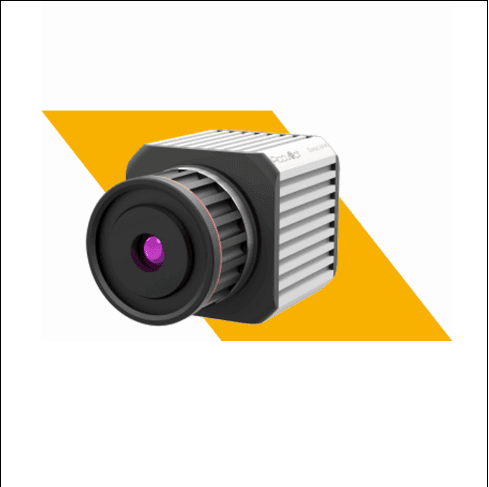
A handheld or portable thermal imager fits periodic inspections best: a technician walking a set route, checking equipment at intervals rather than continuously. Tempsens builds a range of portable models for this, including the ThermEye 256 and ThermEye 256M at 256×192 resolution, with higher-resolution options going up to 480×360 and 640×512 depending on how much image detail a given route actually calls for. These combine infrared and visible image fusion with multiple color palettes and a rugged build; the ThermEye 256 carries an IP54 protection rating and roughly 11 hours of working time on a charge, enough for a full shift of fieldwork.
Online or Fixed Cameras for Continuous Monitoring
Some equipment is critical enough that periodic checks simply aren’t sufficient. For that, an online or fixed thermal imaging camera stays mounted in place and streams thermal data continuously, watching for temperature variations around the clock and triggering an alert the moment something drifts outside its normal range. This makes sense for assets where catching an issue a week or two earlier than the next scheduled walk-through genuinely matters.
What to Look for in a Thermal Imaging Camera
Resolution and Sensitivity
Detector resolution is simply how many pixels make up the image, and a higher pixel count usually means sharper detail and better accuracy for isolating a small hot spot in a crowded scene. That matters far more in a busy electrical panel or a complex machine layout than it does for one isolated piece of equipment sitting on its own.
Temperature Range
Not every job needs the same range. General maintenance work might only call for something around -20°C to 150°C, while a furnace or kiln inspection needs a camera rated well past that, up to roughly 550°C in some Tempsens models. Matching the range to the actual job avoids paying for more camera than the work needs, or worse, under-specifying it.
Focus Method and Ease of Use
Some cameras use manual focus, which suits precise targeting on one known component. Others are focus-free, built for a faster, broader sweep across many pieces of equipment. Which one makes sense really comes down to whether the inspection needs pinpoint accuracy or quick coverage.
How Predictive Maintenance With Thermal Imaging Actually Works in Practice
It usually starts with a baseline: a thermal signature taken while the equipment is running normally. From there, every later scan gets compared against that baseline, and anything that drifts away from it flags a potential problem. Over time, this builds up a record that helps a maintenance team spot patterns across similar equipment, plan work around scheduled downtime instead of emergencies, and keep documentation on hand for safety reviews or regulatory checks.
Final Thoughts
A thermal imager gives a maintenance team something reactive maintenance never can: a chance to see trouble coming. A loose connection, a bearing running hot, a furnace section losing its insulation. Picking the right imager comes down to matching resolution, temperature range, and monitoring style, portable or fixed, to the equipment that actually needs watching, rather than reaching for whatever camera happens to be sitting in the toolbox.