
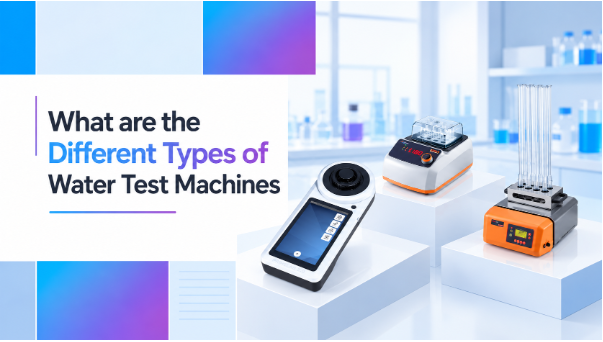

Water quality testing is an extremely critical aspect of pharmaceutical, research, and industrial applications that ensures all safety measures are met and for process efficiency. From chemical oxygen demand (COD) to total dissolved solids (TDS) or organic pollutants, choosing the right water test machines assures accurate, reproducible results. This guide will discuss the different types of water test systems and their characteristics.
Contents
- 1 Photometric Water Testing for Optical Precision for Multi-Parameter Analysis
- 2 COD Digesters are Essential for Wastewater and Industrial Effluent Testing
- 3 Conductivity Meters for Measuring TDS and Salinity
- 4 Titration Systems for Water Hardness and Alkalinity Analysis
- 5 Turbidity Meters to Measure Water Clarity and Suspended Solids
- 6 pH and ORP Meters are Critical for Water Chemistry Monitoring
- 7 Total Organic Carbon (TOC) Analysers to Check Organic Contaminants
- 8 Laboratory Glass Reactor in Water Testing Applications
- 9 Conclusion
Photometric Water Testing for Optical Precision for Multi-Parameter Analysis
Photometers play a fundamental role in water testing by using optical sensors to measure the absorption of light in reaction with specific reagents.
Key Features of Photometers
- Multi-Wavelength Coverage: Systems like the Borosil Scientific Primelab 2.0 use 18 wavelengths for precise analysis of over 140 water parameters.
- Advanced User Interface: Integrated 5.5” HD touchscreen guides users through test procedures with interactive animations.
- Reagent and Sample Traceability: QR-code scanner ensures reliable reagent tracking and data accuracy.
- Connectivity for Real-Time Monitoring: WiFi-enabled LabCOM® transfers data seamlessly to lab systems.
- Probes for Extended Testing Capabilities: Compatible with pH, ORP, EC, and temperature probes.
Photometers are essential for field-based water testing, offering lab-grade accuracy with the flexibility of on-site analysis.
COD Digesters are Essential for Wastewater and Industrial Effluent Testing
COD (Chemical Oxygen Demand) analysis quantifies organic pollutants in water, making it a crucial test for industrial wastewater treatment and regulatory compliance.
Closed Reflux COD Digesters
- Multi-Parameter Capability: Determines COD, trace metals, TOC, total phosphate, and total nitrogen.
- One-Touch Operation: Simplified testing with automated digestion cycles.
- Enhanced Safety Features: UV-protective lid prevents chemical exposure.
Open Reflux COD Digesters
- High-Temperature Operation: Reaches 180°C, with rapid heating from 20°C to 160°C in under 20 minutes.
- Automated Process Control: Includes graphical time-temperature monitoring and auto shut-off with an alert system.
- Insulated Heating Block: Prevents heat loss and ensures operator safety.
COD digesters are essential for laboratories conducting wastewater compliance testing, improving analysis efficiency and process repeatability.
Conductivity Meters for Measuring TDS and Salinity
Conductivity meters assess the ionic content of water, crucial for industries that require high-purity water.
Why Conductivity Matters?
- Pharmaceutical and Food Industries: Ensures water purity in production lines.
- Power Plants: Monitors boiler feed water quality.
- Environmental Monitoring: Evaluates salinity and pollution levels in natural water sources.
Modern conductivity meters offer TDS, EC, and temperature readings, providing a comprehensive assessment of water purity.
Titration Systems for Water Hardness and Alkalinity Analysis
Titration systems automate the measurement of alkalinity, chloride, and hardness, eliminating human error in endpoint detection.
Advantages of Automated Titration
- Real-Time Titration Curve Monitoring: Provides high-precision dosing.
- Multiple Sample Handling: Supports various titrants and reagents.
- User-Friendly Automation: Minimises operator intervention.
These systems are widely used in municipal water treatment plants, beverage industries, and chemical laboratories.
Turbidity Meters to Measure Water Clarity and Suspended Solids
Turbidity meters analyse suspended particles in water, indicating contamination levels.
Turbidity Testing Applications
- Drinking Water Quality: Ensures compliance with turbidity limits for potable water.
- Industrial Process Water: Prevents blockages and inefficiencies in manufacturing.
- Environmental Impact Studies: Monitors sediment runoff in rivers and lakes.
High-sensitivity infrared turbidity meters provide consistent, stable measurements, minimising variability in results.
pH and ORP Meters are Critical for Water Chemistry Monitoring
pH and ORP (oxidation-reduction potential) meters assess acid-base balance and chemical reactivity, crucial in water treatment applications.
Applications of pH and ORP Meters
- Industrial Water Treatment: Regulates pH adjustment chemicals.
- Drinking Water Testing: Ensures compliance with pH safety limits.
- Environmental Research: Tracks acidification and pollution effects in water bodies.
pH and ORP meters are available in portable, benchtop, or multi-parameter systems.
Total Organic Carbon (TOC) Analysers to Check Organic Contaminants
TOC analysers detect organic pollutants in high-purity water systems.
Why TOC Testing is Important?
- Pharmaceutical Water Systems: Makes sure there is pure water for drug formulations.
- Municipal Water Quality Control: Identifies organic pollution levels.
- Industrial Effluent Monitoring: Tracks wastewater treatment effectiveness.
TOC analysers provide continuous monitoring, crucial for process validation and environmental compliance.
Laboratory Glass Reactor in Water Testing Applications
While primarily used in chemical synthesis, laboratory glass reactors are also integral in developing and testing water treatment processes.
Reactor-Based Water Testing Applications
- Catalyst Efficiency Testing: Evaluates adsorption and degradation of pollutants.
- Chemical Synthesis: Develops and optimises new water treatment formulations.
- Reaction Kinetics Studies: Simulates purification reactions before scale-up.
Laboratory glass reactors enable researchers to test and refine water treatment solutions before full-scale implementation.
Selecting the Right Water Test Machine for Your Laboratory
Choosing the appropriate water test machine depends on analytical requirements and operational constraints.
| Instrument | Best For |
| Photometer | Portable, high-precision water analysis |
| COD Digester | Industrial wastewater and effluent testing |
| Titration System | Hardness, alkalinity, and chloride monitoring. Borosil Scientific AutoBurettes offer a reservoir, rubber bellow and automatic zero facility for titration applications. |
| Conductivity Meter | Purity assessment in high-precision industries |
| Turbidity Meter | Water clarity and sediment measurement |
| pH/ORP Meter | Acid-base balance and oxidation potential testing |
| TOC Analyser | High-purity water monitoring and pollution tracking |
| Spectrophotometer | Research and chemical development in water treatment |
Conclusion
Understanding the different types of water test machines ensures laboratories and industries make informed decisions for regulatory compliance and process efficiency.
From field-based photometric testing to high-accuracy TOC testing, every instrument delivers essential water quality insights. Sophisticated automation, digital monitoring, and multi-parameter test capabilities also augment accuracy, reliability, and reproducibility of results.
For research laboratories specialising in water purification, incorporating a spectrophotometer enables systematic analysis of water quality parameters, ensuring treatment effectiveness before industrial application.
Choosing the correct water test machine ensures compliance, precision, and eco-friendliness in water management.