

Artificial intelligence is rapidly moving beyond simple chatbots and content generation tools. Organisations are increasingly seeking AI systems capable of handling complex workflows, coordinating multiple tasks, and making decisions across interconnected business processes.
To achieve these capabilities, many enterprises are turning to multi-agent AI architectures powered by large language models (LLMs). At the centre of this transformation is multi-agent LLM orchestration.
From Single AI Assistants to Collaborative AI Systems
Early enterprise AI solutions typically relied on a single language model responsible for every task. While effective for basic interactions, this approach often encounters limitations when workflows become more sophisticated.
Business operations frequently require multiple specialised functions, including:
- Information retrieval
- Data analysis
- Code generation
- Customer communication
- Document processing
- Workflow automation
Expecting a single model to excel at all these responsibilities can create inefficiencies and reduce overall system performance.
Multi-agent architectures address this challenge by assigning different responsibilities to specialised AI agents.
What Is a Multi-Agent AI System?
A multi-agent AI system consists of several independent agents working together to achieve a shared objective.
Each agent may be responsible for a specific task, such as:
- Gathering information
- Evaluating data
- Generating recommendations
- Interacting with external systems
- Validating outputs
- Monitoring compliance requirements
Rather than operating in isolation, these agents communicate and collaborate throughout the workflow.
This approach mirrors how human teams operate, with different specialists contributing expertise to achieve a common goal.
Why Orchestration Matters
As the number of agents increases, coordination becomes significantly more complex.
Without proper management, organisations may encounter:
- Duplicate work
- Conflicting outputs
- Inefficient resource usage
- Increased operational costs
- Reduced reliability
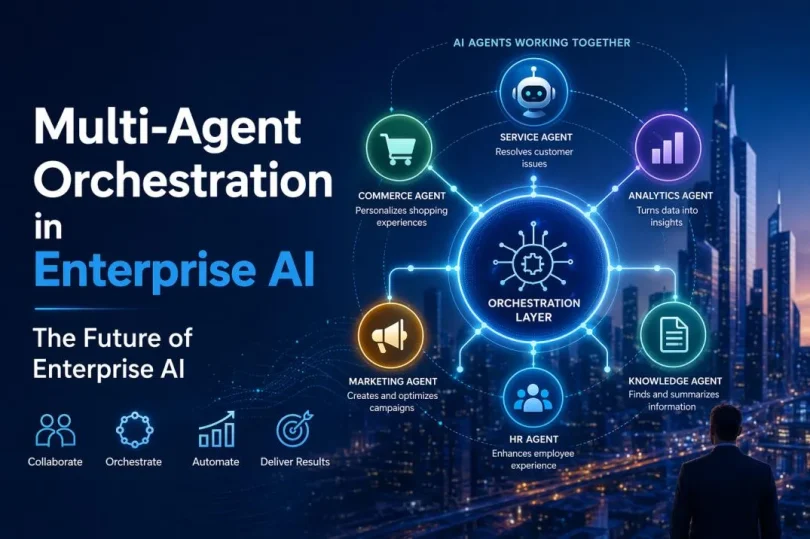
This is where multi agent llm orchestration becomes essential.
Orchestration frameworks coordinate communication between agents, manage task execution, allocate resources, track progress, and ensure workflows remain aligned with business objectives.
The orchestration layer effectively acts as the control centre for the entire AI ecosystem.
Key Components of Multi-Agent Orchestration
Successful orchestration platforms typically include several critical capabilities.
Task Routing
Incoming requests must be assigned to the most appropriate agent based on expertise, workload, and business requirements.
Workflow Coordination
Many enterprise processes involve multiple stages. Orchestration systems ensure agents execute tasks in the correct sequence and share information efficiently.
Memory and Context Management
Agents often require access to shared knowledge, historical interactions, and business data.
Orchestration enables consistent context across the entire workflow.
Tool and System Integration
Enterprise AI agents frequently interact with CRMs, ERPs, databases, analytics platforms, and third-party APIs.
Coordinating these integrations is essential for delivering reliable outcomes.
Governance and Monitoring
Organisations need visibility into performance, security, compliance, and operational costs.
Orchestration platforms provide centralised oversight and control mechanisms.
Enterprise Use Cases
Multi-agent architectures are already being applied across numerous industries.
Examples include:
Customer Service Automation
One agent retrieves customer information, another analyses support history, while a third generates responses and recommendations.
Software Development
Different agents can handle code generation, testing, documentation, security analysis, and deployment support.
Financial Operations
AI agents may collaborate on invoice processing, compliance verification, risk assessment, and reporting.
Healthcare Administration
Multiple agents can assist with documentation, scheduling, claims processing, and patient communication workflows.
These use cases demonstrate how coordinated AI systems can handle tasks that would be difficult for a single model to manage effectively.
Benefits of Multi-Agent Architectures
Compared with traditional AI deployments, multi-agent systems offer several advantages:
- Improved scalability
- Greater task specialisation
- Enhanced reliability
- Better decision quality
- Increased operational efficiency
- Lower long-term costs
- Easier integration with enterprise systems
By distributing responsibilities across multiple agents, organisations can build more resilient and adaptable AI solutions.
Looking Ahead
Enterprise AI is evolving from isolated language models toward intelligent ecosystems composed of specialised agents working together.
As organisations continue to adopt advanced automation, the ability to coordinate multiple AI agents efficiently will become a major competitive advantage. Companies that invest in orchestration frameworks today will be better positioned to scale AI initiatives, improve operational performance, and adapt to future innovations.
The future of enterprise AI is unlikely to be driven by a single model. Instead, it will be shaped by networks of intelligent agents working collaboratively through sophisticated orchestration layers that enable truly autonomous business processes.