
The telemetrics meaning, in short: it’s the practice of collecting data from a vehicle or a piece of equipment – location, speed, engine status, fuel use – and sending that data over a wireless network to a central system where someone can act on it. Most people use “telemetrics” as a variant of “telematics,” the industry term that combines telecommunications and informatics. In fleet tracking and asset monitoring, this is the technology behind the little dot moving across a dispatcher’s screen and the alert that pops up when a truck idles too long, or a tool leaves a job site without being checked out.
Contents
- 1 Where the Term Comes From (and Why Spelling Gets Messy)
- 2 How Telemetric Systems Actually Work in Fleet Tracking
- 3 Why This Concept Extends Beyond Vehicles
- 4 Key Benefits Fleet and Asset Managers Get From Telemetric Data
- 5 Common Mistakes When Choosing or Interpreting a Telemetric System
- 6 The Bottom Line
- 7 Frequently Asked Questions
Where the Term Comes From (and Why Spelling Gets Messy)
Search engines see both “telematics” and “telemetrics” typed by people looking for the same thing, so it’s worth clearing this up early. The original word, telematics, was coined decades ago by combining “telecommunications” and “informatics.” Telemetry – the remote measurement of data, used heavily in aerospace and medicine – is a close cousin, and it’s likely where “telemetrics” as a spoken shorthand took hold.
For this article, this term and the standard telematics definition are treated as the same thing, because that’s how it functions in day-to-day fleet and asset conversations. Whether a manager searches for this spelling or the more common one, they’re almost always trying to understand the same category of technology.
A Quick Working Definition
If you only remember one line, make it this: a telemetric system pairs a physical sensor or GPS unit with a communication link, so information about a vehicle, machine, or asset can travel somewhere useful without a person manually recording it.
How Telemetric Systems Actually Work in Fleet Tracking
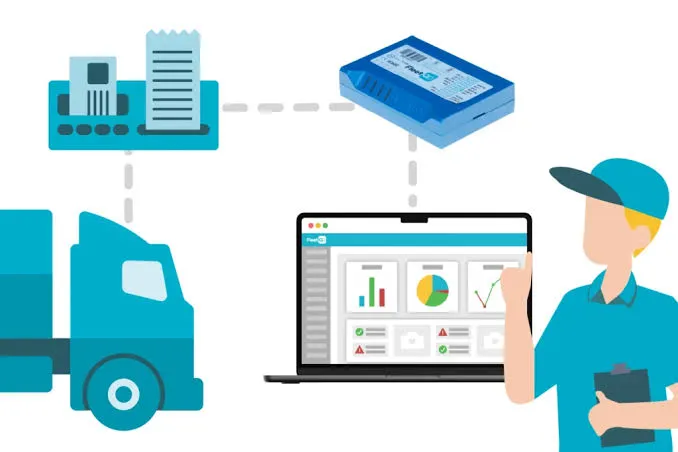
A fleet telemetric setup isn’t one single gadget – it’s a chain of parts working together. Understanding each piece makes the telemetric meaning less abstract and more practical.
- The onboard unit or tag. A small device, often connected to a vehicle’s diagnostic port or attached directly to equipment, gathers raw data such as position, speed, temperature, or usage hours.
- The connectivity layer. Cellular networks, GPS/GNSS satellites, or low-power wireless protocols like LoRaWAN and Bluetooth carry that data from the field to a server.
- The software platform. A dashboard turns raw numbers into maps, reports, and alerts that a fleet or operations manager can actually read and respond to.
This three-part structure is fairly consistent whether you’re tracking a delivery truck, a forklift, or a case of tools moving between a warehouse and a customer site. The hardware and network might differ – a truck usually relies on cellular and GPS, while a small tool tag might rely on Bluetooth beacons inside a building – but the underlying logic stays the same. That adoption curve shows up clearly in the numbers: the commercial vehicle telematics market was valued at roughly USD 5.4 billion in 2024 and is projected to reach USD 12.8 billion by 2030, growing at close to 15 percent a year as more fleets move from basic GPS tracking toward full diagnostic and safety platforms.
Why This Concept Extends Beyond Vehicles
It’s easy to assume telemetric data only applies to trucks and vans, but that’s a narrow read. On-site service businesses – construction crews, field technicians, manufacturing teams – deal with the same core problem fleets do: something valuable is moving around, and nobody wants to guess where it is. Businesses researching the telemetrics meaning behind on-site asset tracking often discover tools and containers need the same visibility as trucks on the road.
Tools, spare parts, mobile equipment, and load carriers can carry the same kind of low-power tracking tags used in fleet telemetrics, reporting their location automatically as they move between a warehouse, a workshop, and a job site. This is really an extension of the same idea: instead of a truck reporting its position on a highway, a wrench or a pallet reports its position inside a building or yard. The underlying process doesn’t change – data collection plus wireless transmission plus a usable dashboard – only the scale and the setting shift.
Key Benefits Fleet and Asset Managers Get From Telemetric Data
Once a business understands how this technology works in practice, the appeal becomes obvious. Here’s what tends to show up on a manager’s list of reasons to adopt it:
- Lower fuel and operating costs. Idling time, harsh braking, and inefficient routes all show up in the data, giving managers concrete numbers to act on instead of guesswork.
- Fewer lost or misplaced assets. Tools and equipment that report their own location cut down on the search time crews spend hunting for a missing item before a job can even start.
- Better maintenance planning. Engine diagnostics and usage hours flag wear before it becomes a breakdown, shifting maintenance from reactive to predictive.
- Stronger safety and compliance records. Driver behavior data – speeding, harsh cornering, excessive hours – supports coaching programs and regulatory logging requirements.
- Faster dispatch decisions. Real-time location data lets a dispatcher assign the closest available vehicle or technician instead of relying on a phone call.
This isn’t just a sales pitch from tracking vendors, either. A 2025 analysis from Global Market Insights found that GPS trackers, telematics control units, dashcams, and IoT sensors made up around 18 percent of the fleet management market that year, with that hardware segment growing at close to 17.9 percent annually as devices get cheaper but more capable.
The same report pointed to AI-driven safety features and predictive maintenance tools as some of the biggest product launches from major telematics providers in 2025, reflecting a shift from simple location tracking toward automated decision support.
Common Mistakes When Choosing or Interpreting a Telemetric System
Even with a clear telemetric meaning in hand, businesses still trip up when selecting or reading data from these systems. Watch out for these three patterns:
- Treating raw data as an answer. A dashboard full of speed and idle-time numbers means nothing without someone reviewing it regularly and turning it into action, like driver coaching or route changes.
- Ignoring assets that aren’t vehicles. Companies often track trucks closely while leaving tools, containers, and equipment completely unmonitored, even though those items are just as easy to lose.
- Picking hardware before mapping the actual site conditions. A tracker built for open-road GPS won’t perform well inside a warehouse or underground parking structure, where Bluetooth or RFID-based localization usually works better.
The Bottom Line
In short, this technology boils down to a simple chain: sensors collect data, a network moves it, and software turns it into something a person can act on. Fleet managers use it to cut fuel costs and prevent breakdowns.
On-site service teams use the same logic to stop losing tools and equipment between the warehouse and the job site. Once that connection clicks, choosing the right system becomes less about jargon and more about matching the right hardware to the setting where the tracking actually needs to happen.
Frequently Asked Questions
What is telematics, in plain terms?
It’s a method of monitoring vehicles, equipment, and other assets using GPS and onboard diagnostics, so their location and condition show up on a computerized map instead of being tracked by hand.
What are telematic devices, and how do they work?
These are hardware units – often installed in a vehicle’s diagnostic port or attached to equipment – that collect data like position, speed, or engine status and transmit it over a network to a software platform.
What is telematics in fleet management specifically?
It refers to a device fitted to a vehicle that communicates with GPS and cellular networks, tracking whereabouts, driver behavior, engine diagnostics, and other metrics that a fleet manager can review remotely.
Is there a real difference between telemetry and telematics?
Yes, though they’re related. Telemetry is strictly the remote measurement and transmission of data, used across fields like aerospace and medicine. Telematics builds on telemetry by adding telecommunications and software integration, which is why the two terms sometimes get blended into “telemetrics.”
Do telematics systems work for equipment other than cars and trucks?
Yes. The same principles apply to construction equipment, tools, containers, and even lone workers carrying a tracking tag — anything that benefits from automatic location and status reporting can use a version of this technology.