
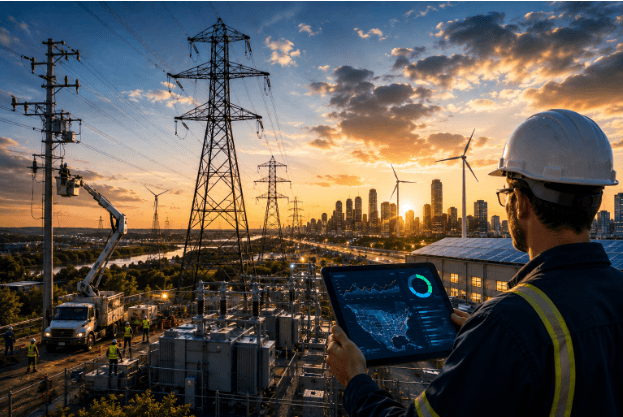

For most people, the electrical grid is something they rarely think about. Flip a switch and the lights come on. Plug in a computer, charge an electric vehicle, or start a production line, and electricity is simply expected to be there. That level of reliability has become so routine that it is easy to forget just how much infrastructure sits behind every business, hospital, factory, office building, and community.
Across North America, however, that infrastructure is entering one of the most important periods in its history.
Much of today’s transmission and distribution network was constructed decades ago to support an economy that looked very different from the one we have today. Electricity demand was more predictable, industrial operations were less automated, and technologies such as electric vehicles, hyperscale data centres, battery manufacturing, and artificial intelligence simply did not exist. Utilities focused primarily on delivering electricity from centralized generating stations to homes and businesses, and for many years that model served the continent remarkably well.
The economy has changed far more quickly than the infrastructure supporting it.
Manufacturing is becoming increasingly automated, requiring more sophisticated electrical systems than previous generations of production facilities. Distribution centres now operate around the clock using robotics and advanced logistics technology. Hospitals depend on highly specialized medical equipment, while commercial buildings have evolved into digitally connected environments filled with automation systems that continuously monitor lighting, security, ventilation, and occupancy.
Even transportation is becoming more dependent on electricity.
Electric vehicle adoption continues expanding across Canada and the United States, prompting investment in charging infrastructure while encouraging utilities to rethink how local distribution systems will support future demand. At the same time, companies developing artificial intelligence platforms continue constructing large data centres that require reliable electricity twenty-four hours a day.
None of these developments are temporary.
Most industry forecasts suggest electricity demand will continue increasing steadily throughout the next two decades as industrial electrification accelerates and digital infrastructure expands. That growth represents an enormous opportunity for economic development, but it also creates significant planning challenges for utilities responsible for maintaining reliable service.
Building new infrastructure is rarely simple.
Transmission corridors require environmental assessments, public consultation, engineering studies, regulatory approvals, and substantial capital investment before construction even begins. New substations, distribution upgrades, and generation projects often take years to complete, making long-term planning essential.
Because of those realities, utilities are increasingly looking beyond infrastructure construction alone.
Improving the efficiency of existing systems has become just as important as building new ones. Better operational visibility, advanced monitoring technologies, predictive maintenance, and closer collaboration with industrial customers all help utilities maximize the value of assets already in service while preparing for future expansion.
Industrial organizations have become important partners in that effort.
Large manufacturing facilities, mining operations, food processors, universities, hospitals, airports, and commercial property portfolios collectively consume enormous amounts of electricity every day. Understanding how these organizations use energy provides valuable insight that supports infrastructure planning while helping businesses improve their own operational performance.
Technology has made that collaboration considerably easier.
Connected sensors, smart electrical meters, automation platforms, and advanced analytics now provide detailed visibility into electricity consumption across individual facilities. Rather than relying exclusively on historical trends, utilities and businesses can evaluate operational data in near real time, helping identify emerging patterns that support more informed planning decisions.
This evolution has also expanded the role of organizations specializing in industrial energy planning.
An experienced energy services company helps businesses understand how energy supports their operations while identifying opportunities to improve efficiency, strengthen resilience, and prepare for an increasingly electrified economy. Those insights benefit individual organizations, but they also contribute to broader infrastructure planning by encouraging more efficient use of existing electrical systems.
One thing is becoming increasingly clear.
The conversation surrounding electricity is no longer limited to building more generation or replacing aging transmission lines. It has expanded to include operational intelligence, long-term planning, and collaboration between utilities and the businesses that depend on reliable power every day.
One of the reasons this investment cycle is attracting so much attention is that it extends far beyond replacing aging equipment. Utilities are not simply rebuilding the grid that existed twenty or thirty years ago. They are designing an electricity system capable of supporting a very different economy, one in which digital technologies, automation, advanced manufacturing, and electrified transportation all require levels of reliability and flexibility that were not anticipated when much of today’s infrastructure was originally constructed.
That distinction matters because replacing old infrastructure with newer versions of the same technology would do little to prepare the electrical system for future demand.
Today’s investment decisions are increasingly focused on modernization. Across North America, utilities are deploying intelligent substations, digital monitoring systems, automated switching equipment, advanced metering technologies, and sophisticated grid management platforms capable of providing operators with real-time visibility into conditions across thousands of kilometres of transmission and distribution infrastructure. These technologies allow potential issues to be identified much earlier, reducing the likelihood of outages while improving overall system performance.
Climate resilience has also become an important part of the discussion.
Severe weather events have demonstrated how vulnerable critical infrastructure can be when exposed to increasingly unpredictable environmental conditions. Utilities are strengthening transmission corridors, improving vegetation management, investing in automated restoration technologies, and redesigning portions of the grid to better withstand storms, flooding, extreme temperatures, and other environmental challenges. These investments are intended not only to restore power more quickly after disruptions but also to reduce the likelihood that widespread outages occur in the first place.
At the same time, industrial customers are becoming more active participants in long-term planning.
Large facilities increasingly recognize that understanding their own electricity requirements helps support both business objectives and infrastructure development. Manufacturers planning production expansions now engage with utilities much earlier in the project lifecycle to ensure sufficient capacity exists before construction begins. Data centre operators evaluate electrical infrastructure as carefully as transportation access or available workforce, while mining companies and food processors often incorporate long-term energy planning into broader capital investment strategies.
This closer coordination benefits everyone involved.
Utilities gain a clearer understanding of future demand, allowing infrastructure investments to be prioritized more effectively. Businesses reduce uncertainty by ensuring electricity requirements are considered early in the planning process. Communities benefit from stronger economic development supported by infrastructure capable of accommodating continued industrial growth.
Technology is making this collaboration increasingly data-driven.
Advanced forecasting tools now incorporate population growth, industrial expansion, weather patterns, economic indicators, and historical consumption data to estimate future electricity requirements with much greater accuracy than was previously possible. Artificial intelligence is beginning to enhance these capabilities further by identifying long-term trends that traditional planning models may overlook, helping utilities allocate investment where it will have the greatest impact.
For industrial organizations, these developments reinforce the importance of understanding energy as more than simply another operating expense.
Reliable electricity has become a strategic business requirement. Every automated production line, distribution centre, research laboratory, healthcare facility, and commercial office building depends on infrastructure that operates reliably every hour of every day. As organizations invest in digital transformation, the value of dependable electrical infrastructure continues to grow.
This is also changing expectations surrounding operational efficiency.
Businesses increasingly recognize that making better use of existing electrical infrastructure benefits both their own operations and the broader electricity system. Improvements in equipment performance, operational planning, maintenance practices, and facility management reduce unnecessary demand while helping organizations operate more competitively. When those improvements occur across thousands of facilities, they contribute to a stronger and more resilient grid capable of supporting continued economic growth.
The pace of investment now underway reflects the scale of the challenge ahead.
Utilities throughout North America are committing billions of dollars toward modernizing transmission networks, expanding distribution systems, integrating renewable generation, strengthening cyber resilience, and deploying advanced digital technologies. Governments continue supporting these investments because they recognize that reliable electricity infrastructure has become essential to economic competitiveness, national security, and long-term prosperity.
Looking ahead, the importance of these projects will only continue growing.
The transition toward electrified transportation, advanced manufacturing, artificial intelligence, and increasingly connected communities will place additional demands on electricity systems throughout the coming decades. Meeting those demands will require not only continued investment but also closer collaboration between utilities, industry, governments, and technology providers.
Perhaps the most important takeaway is that North America’s electrical grid is no longer simply being maintained. It is being reimagined for a different economy. The infrastructure being planned and constructed today will support industries that continue evolving rapidly, technologies that are still emerging, and communities that will depend even more heavily on reliable electricity than they do today.
The businesses that recognize this transformation early will be better prepared to make informed investment decisions, strengthen operational resilience, and position themselves for long-term growth. Reliable electricity has always been fundamental to economic development. The difference now is that the infrastructure supporting it has become one of the most strategic investments shaping North America’s future.