

One of the least visible responsibilities performed by electric utilities happens long before electricity ever reaches a home, office, or manufacturing plant. Every day, system operators make thousands of decisions based on one fundamental question: how much electricity will customers need tomorrow?
For decades, answering that question was relatively straightforward.
Historical demand patterns were remarkably consistent. Residential consumption followed predictable daily routines, commercial buildings operated within established business hours, and industrial facilities generally maintained stable production schedules. While weather and economic activity certainly influenced electricity demand, forecasting models were able to rely heavily on historical data because customer behaviour changed gradually over time.
That is no longer the environment utilities operate in today.
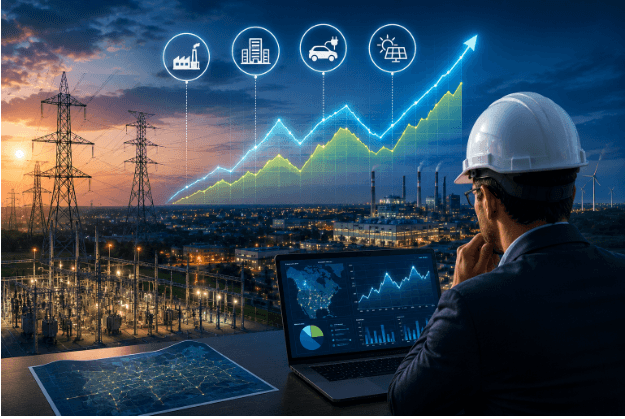
Across North America, electricity demand has become considerably more dynamic. Manufacturing continues expanding in many regions, artificial intelligence is driving unprecedented investment in data centres, electric vehicle adoption is increasing steadily, and industries ranging from mining to food processing are electrifying equipment that previously relied on fossil fuels. At the same time, renewable energy generation introduces greater variability into electricity supply, requiring system operators to balance changing demand with changing generation throughout the day.
Forecasting has therefore become significantly more complicated.
Utilities can no longer rely exclusively on historical consumption patterns because the economy itself is changing. New manufacturing facilities may increase demand substantially within a relatively short period. Data centres supporting cloud computing often require large amounts of continuous electricity, while electric vehicle charging introduces consumption patterns that differ from traditional residential demand.
Each individual development appears manageable.
Collectively, however, they create an electricity system where accurate forecasting has become one of the most valuable operational tools available.
Good forecasts influence almost every aspect of utility operations.
Generation resources must be scheduled appropriately. Transmission systems need sufficient capacity to move electricity where it is required. Maintenance activities must be coordinated without affecting reliability, while electricity markets rely on accurate estimates of future demand to support efficient system operation.
Errors become expensive very quickly.
Overestimating demand may require unnecessary generating resources to remain available, increasing operating costs. Underestimating demand can place additional stress on the electrical system while reducing operational flexibility during periods of high consumption. Utilities therefore continue investing heavily in technologies that improve forecasting accuracy.
Artificial intelligence has become an important part of this evolution.
Rather than relying primarily on historical averages, modern forecasting platforms evaluate weather conditions, economic activity, industrial development, historical operating patterns, calendar effects, and dozens of additional variables simultaneously. Machine learning algorithms continuously refine their predictions as new information becomes available, allowing utilities to adapt more effectively as operating conditions change.
Industrial customers play an increasingly important role in these forecasts.
Large manufacturing facilities, mining operations, commercial real estate portfolios, hospitals, universities, and logistics centres represent significant electrical loads whose operating patterns can meaningfully influence local electricity demand. Understanding planned expansions, production schedules, and operational changes helps utilities develop more accurate forecasts while allowing businesses to better coordinate with electricity providers.
This collaborative approach reflects a broader transformation occurring throughout the energy sector.
Utilities and industrial organizations increasingly recognize that better information benefits everyone involved. Businesses receive more reliable service supported by infrastructure planned around realistic demand expectations, while utilities gain greater visibility into changing consumption patterns that support long-term investment decisions.
As electricity demand continues evolving, organizations are also relying on experienced energy services company partners to help evaluate future requirements, analyze operational growth, and align facility planning with available electrical infrastructure. Better forecasting begins with better information, and businesses that understand their own future energy needs are often better positioned to support both operational growth and broader utility planning.
Perhaps the most interesting aspect of load forecasting is that it has quietly evolved from a mathematical exercise into a strategic discipline influencing virtually every investment decision made throughout the electricity sector.
The growing importance of load forecasting reflects a broader change taking place across the electricity industry. Utilities are no longer planning for an economy where electricity demand grows gradually and predictably over time. Instead, they are supporting an environment where major industrial investments, technological innovation, and changing consumer behaviour can alter demand patterns much more quickly than in previous decades.
A single advanced manufacturing facility, for example, may require as much electricity as a small community. A hyperscale data centre can introduce a continuous electrical load unlike almost anything utilities have historically managed. Battery manufacturing plants, electric vehicle production facilities, food processing operations, and mining projects all create substantial new demand, often within relatively short development timelines.
For utility planners, that means forecasting has become as much about understanding economic development as it is about understanding electricity.
Population growth remains an important variable, but it is no longer sufficient on its own. Utilities now monitor commercial construction, industrial expansion, transportation trends, government policy, and regional investment activity because each has the potential to influence future electricity requirements. The closer forecasting models align with real economic activity, the more effectively utilities can prioritize infrastructure investments.
Weather continues to play a critical role as well.
Extreme temperatures influence residential and commercial electricity consumption through heating and cooling demand, while changing weather patterns can also affect renewable energy generation. Wind conditions influence turbine output, cloud cover affects solar production, and prolonged periods of extreme heat or cold can increase electricity demand across multiple customer groups simultaneously. Modern forecasting therefore requires utilities to evaluate both consumption and generation with much greater precision than was previously necessary.
This increasing complexity has accelerated the adoption of digital technologies throughout the sector.
Utilities now combine advanced weather modelling, historical operating information, geographic information systems, economic forecasting, and real-time operational data into highly sophisticated planning platforms. Artificial intelligence enhances these capabilities by continuously evaluating relationships across thousands of variables, identifying emerging trends that may not yet be obvious through traditional forecasting methods.
The objective is not simply to predict tomorrow’s demand more accurately.
It is to support better long-term decisions.
Forecasts influence when substations should be expanded, where new transmission infrastructure should be constructed, how generation resources should be developed, and which regions are likely to require additional electrical capacity as economic activity continues to evolve. Every major infrastructure investment begins with assumptions about future electricity demand, making forecasting one of the most influential processes within the utility industry.
Industrial organizations also benefit from this planning.
Companies considering facility expansions increasingly engage with utilities well before construction begins to understand available electrical capacity, expected infrastructure improvements, and long-term system development plans. These conversations reduce uncertainty for both parties. Businesses gain confidence that future operations can be supported reliably, while utilities receive valuable insight into emerging demand that can be incorporated into future planning activities.
This collaboration is becoming increasingly valuable as industrial projects become larger and more technologically sophisticated.
Many facilities now depend on highly automated production systems operating around the clock. Even relatively short interruptions can have significant operational consequences, making reliable infrastructure a critical factor in investment decisions. Businesses therefore have a strong interest in helping utilities understand future demand as accurately as possible, particularly when expansion plans involve substantial increases in electrical consumption.
Another important trend is the growing use of scenario planning.
Rather than developing a single forecast, many utilities now evaluate multiple possible futures based on different rates of economic growth, industrial investment, electrification, renewable energy adoption, and population change. This approach allows planners to understand how infrastructure requirements may vary under different conditions, reducing long-term planning risk while improving investment decisions.
The value of these strategies extends well beyond utility operations.
Communities benefit from stronger infrastructure planning, governments gain greater confidence in economic development initiatives, and businesses are better able to make long-term investment decisions knowing future electrical capacity has been considered as part of regional planning. Accurate forecasting therefore supports economic growth while strengthening the resilience of the electricity system itself.
Looking ahead, forecasting will almost certainly become even more sophisticated.
Artificial intelligence will continue improving predictive models. Smart infrastructure will provide more detailed real-time operating information, while industrial automation and connected technologies will generate richer datasets that improve understanding of how electricity is consumed throughout the economy. Utilities will increasingly shift from reacting to changing demand toward anticipating it, allowing infrastructure investments to be planned with greater confidence and precision.
Perhaps the most important lesson is that forecasting is no longer simply about estimating how much electricity people will use tomorrow. It has become a strategic process that helps shape infrastructure investment, supports industrial development, and influences how effectively North America’s electrical system can respond to an economy that continues becoming more connected, more electrified, and more dependent on reliable power. The organizations that understand these changing dynamics today will be better prepared to support the energy requirements of tomorrow.